
Words & Photography by Aurélien Foucault
Panel report:
Wines Experience HCMC 2026 – The Next Generation Wine Consumer in Southeast Asia – 26 June 2026, The ADORA Center, Ho Chi Minh City
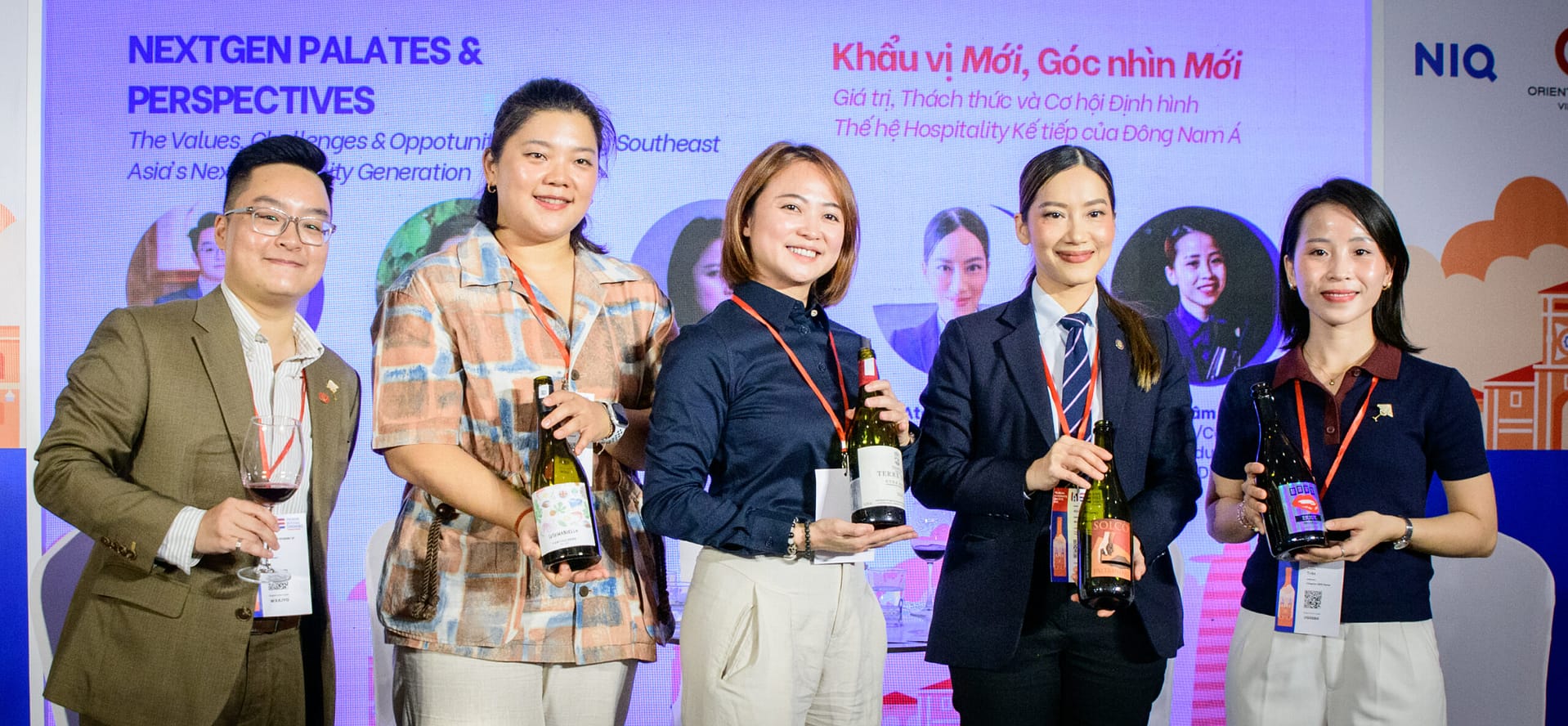
Moderated by Ms. Khan Vi Le Hoang (Vice-President, Vietnam Sommelier Association; Beverage Director, Nén restaurants), with Ms. Minyoung Ryu (Head Sommelier, Potato Head Family, Bali), Ms. Happy Gan (Business Development Manager, DC Selections, Kuala Lumpur), Khun Atchara ‘Apple’ Wongthai Palleros (Wine Training Manager, Central Food Retail Co., Thailand), Ms. Trâm Tran (Vice-President, Vietnam Sommelier Association, Hanoi)
On the second day of Wines Experience, June 26th 2026, five wine professionals from four Southeast Asian markets gathered on stage. This panel was fun, engaging and insightful – and it was particularly refreshing to see five Asian women from the industry talk about their market, a welcome change from the usual four white guys plus one woman for quota that is so common in wine industry panels.
The panel was also elevated by a tasting of 4 wines presented by the speakers – a Prosecco, an Etna Rosso, a Puglia red, and a Lambrusco.
Here’s a recap of the conversation that moved between consumer behaviour, sommelier education, and what the market might look like in ten years.
Mapping the New Palate: Domestic Habits and Global Influence
To understand the modern Southeast Asian wine landscape, the panel first established the demographic profiles defining the next generation in each country. A common thread emerged: the impact of global exposure and international education on local drinking habits.

In Vietnam, Trâm Tran noted that the momentum of the next-generation wine consumer is substantially driven by young individuals who have lived or studied abroad. Upon returning home, they bring an assimilated appreciation for Western wine culture and weave wine into their everyday lifestyles rather than treating it as an isolated novelty.
A parallel trend is unfolding in Malaysia, where Happy Gan described the core of the new wine-drinking demographic as citizens returning from overseas – younger consumers who are actively chasing a lifestyle defined by social interaction and ambiance. “People are chasing the vibe rather than just the wine itself,” she said.
Apple noted that Thailand’s market is driven by an emerging generation within the middle-to-higher income brackets, marked by a heightened sense of health-consciousness. They are increasingly deliberate about what they consume, showing a preference for cleaner lifestyles, lower-alcohol options, and prioritising quality over volume.
Indonesia presents a dual-market dynamic split between Jakarta and Bali. Minyoung Ryu characterised Jakarta as more settled and predictable, with established drinking habits. Bali, driven by global tourism, is fluid, experimental, and youthful – composed of adventurous domestic travellers and a deeply embedded expatriate community with a high willingness to try unfamiliar wine styles, despite the severe headwinds caused by Indonesia’s high import taxes.
Tax came up in both Bali and Vietnam as a structural constraint. Import duties push wine into a premium price bracket regardless of actual quality, reinforcing its image as an occasion drink rather than an everyday one. Minyoung noted an evolution now taking place in Thailand and Indonesia toward local winemaking as a way around this – if you grow and produce locally, lower taxes and the absence of import costs should facilitate more mainstream access.
From Status Symbol to Everyday Pleasure: Shifting Consumer Motivations
Across all four markets, the panel identified a clear democratisation of wine, moving it away from historical elitism toward approachable lifestyle integration.
Apple laid this out in three parts from a Thai retail and trade perspective. The first is recommendation. Ten to twenty years ago, Thai consumers bought wine based strictly on visible prestige or recognisable labels. Today’s younger buyers want to listen to a sommelier share a narrative about why a wine deserves attention – why this bottle, why this producer, what makes it different. “They want to know why this producer only made one thousand bottles,” she said.

The second is price, with a shift downward – people want something they can buy regularly. There is a growing retail market for affordable everyday wines intended for home consumption. The third is flavour preference. The older generation historically favoured heavy, oaked reds to project status. The new generation shifts toward fresh, lighter styles that offer immediate drinking pleasure and fit occasions beyond the dinner table.
In Vietnam, Trâm Tran described a market still in early transition. Vietnamese consumers are, in her words, the first generation drinking wine – wine was historically imported for foreigners and associated with high prices and special occasions. That association is loosening as wine education grows, but it takes time. “It’s still early, but it’s heading in the right direction,” she said.
Malaysia’s turning point, according to Happy Gan, was the pandemic. During the lockdowns, people explored wine at home. Coming out of COVID, natural wine suddenly appeared everywhere in Malaysia, and younger consumers were drawn to it precisely because it was different and approachable. This shattered the traditional, stuffy perceptions of wine culture. As the market has matured, that interest has deepened into a serious consumer engagement with low-intervention winemaking, organic, biodynamic, and sustainable farming practices. Vi noted from her own observation that Malaysia’s growth has surprised many people who assumed that religious demographics would cap the market.
Humanizing the Glass: The Evolving Role of Hospitality and Education
Apple works with two groups at Tops Wine Cellar: Sommeliers, who already have some experience, and Wine Specialists, who are trained at the starter level. Both share a characteristic: high confidence, high imagination, and an assumption – driven by access to AI and the internet – that they already know what they need to know. “They believe that they know,” she said.
Her approach is to put them into real customer situations immediately, so that the gap between theoretical knowledge and practical application becomes visible quickly. They learn faster that way.
In Malaysia, Happy Gan sees certification as important for a different reason: credibility. Because Malaysia is still an emerging wine market, consumers have genuine doubts about whether a sommelier’s expertise is real. WSET, the Court of Master Sommeliers, and ASI credentials provide visible proof of standard. She noted that the cost is significant – Southeast Asian candidates often need to travel overseas for courses – but young Malaysians are pursuing these qualifications in increasing numbers.

Minyoung shared an experience on AI in the education context. One of her students, preparing for a sommelier exam, confidently told her that a particular grape variety originates from Germany. The source: AI. “AI gives you a plausible-sounding answer, but it doesn’t have the same mechanism as an official source to confirm right or wrong,” she said. She was clear that certification is not an end point. She is currently studying for CNS herself – not to achieve perfection, but because continued study keeps you honest and sharp. “You are only truly good when you genuinely know what you’re talking about with your guests.”
Vi, who teaches at university level, described the same AI problem from a different angle. She gives students thirty minutes to research a topic and they come back in five minutes, finished – via AI. Every student returns with almost identical answers, the same wines, the same food pairings. “You can’t tell them not to use AI,” she said. “What you can do is teach them to verify what AI gives them, to evaluate it, not just copy it.”

From Knowledge to Transmission: Talking to Customers
As Minyoung pointed out, technical language does not work with the new generation. “Methoxypyrazines means nothing to a new consumer,” she said. “If you say ‘Bell pepper’, they understand.” The new consumer wants a personal story from the sommelier – not the appellation regulations, not the technical descriptor, but a human connection to the bottle. “People who are willing to hear your personal story will follow you.”
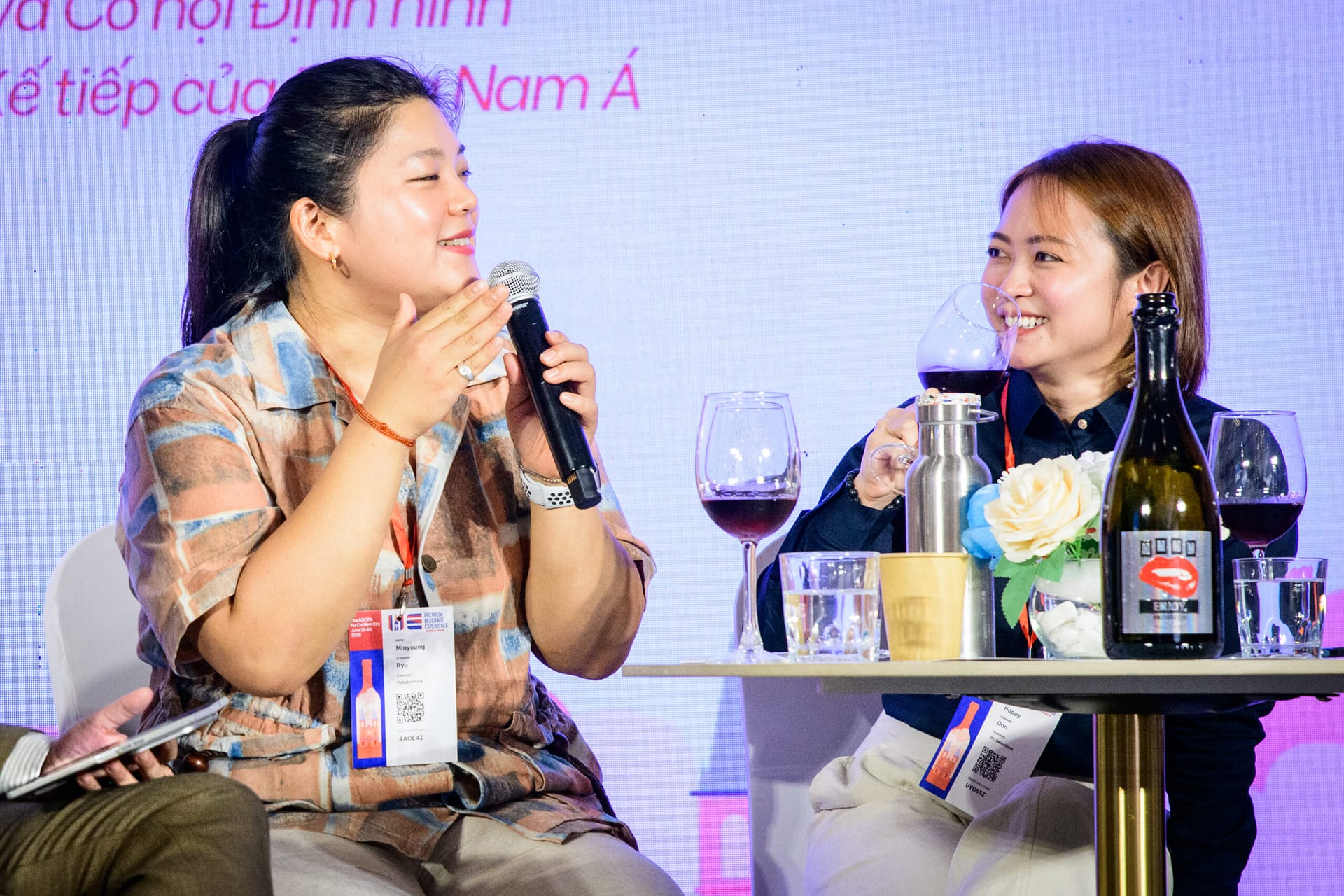
When explaining Italian wine to Vietnamese customers, Trâm Tran uses the map: Italy and Vietnam are both long and narrow countries. Tuscany maps to central Vietnam, Sicily to the south, Veneto to the north-east. Once the customer can place the region in a framework they already understand, the information sticks.
Minyoung described a moment that changed how she works. A guest stopped her mid-description and asked: “What do you mean?” She realised she had been describing wine for herself, not for the customer. “You’re not selling the wine,” she tells her students now. “You’re selling the story.” She passes this on with a specific test: think about whether your parents, sitting at the table, would understand what you’re describing. That’s your benchmark.
Happy Gan applied the same principle to retail, where the challenge is different in scale. Her store carries close to 2,000 SKUs. A new consumer who walks in and faces that selection gets overwhelmed and often leaves without buying anything. Her instruction to her wine specialists: listen first, then present three wines, then give three reasons per wine. “Why this one? It’s organic. It’s medium-bodied. It’s under 2,000 ringgit.” One small story. Then let them go. For the established consumer, the approach can go deeper – monthly tastings, events, exclusive pricing, a lasting relationship.
Looking Ahead: Market Projections for the Next Decade
Apple sees the direction clearly: lower alcohol, lighter styles, sparkling and pétillant naturel. She connects this directly to climate – Southeast Asia is hot, and people want something refreshing. She also connects it to wellness. “The new generation talks about yoga, health, exercise,” she said. “They’re drinking less but better.”

Minyoung added a prediction about producers rather than consumers. She pointed out that historically, winemakers operated in isolation, relying entirely on sommeliers to translate their craft to the public. In ten years, she said, winemakers will need to communicate the way sommeliers do now. “The gap between producer and consumer is closing. And I think that’s a good thing.”
And if you are familiar with Cellar Bridge Magazine’s mission, this is exactly what we are talking about – bridging that gap.
Featured Wines and Tasting Notes
Four wines were poured during the session, each selected by a panelist to illustrate the stylistic shifts and storytelling potential they had been describing.
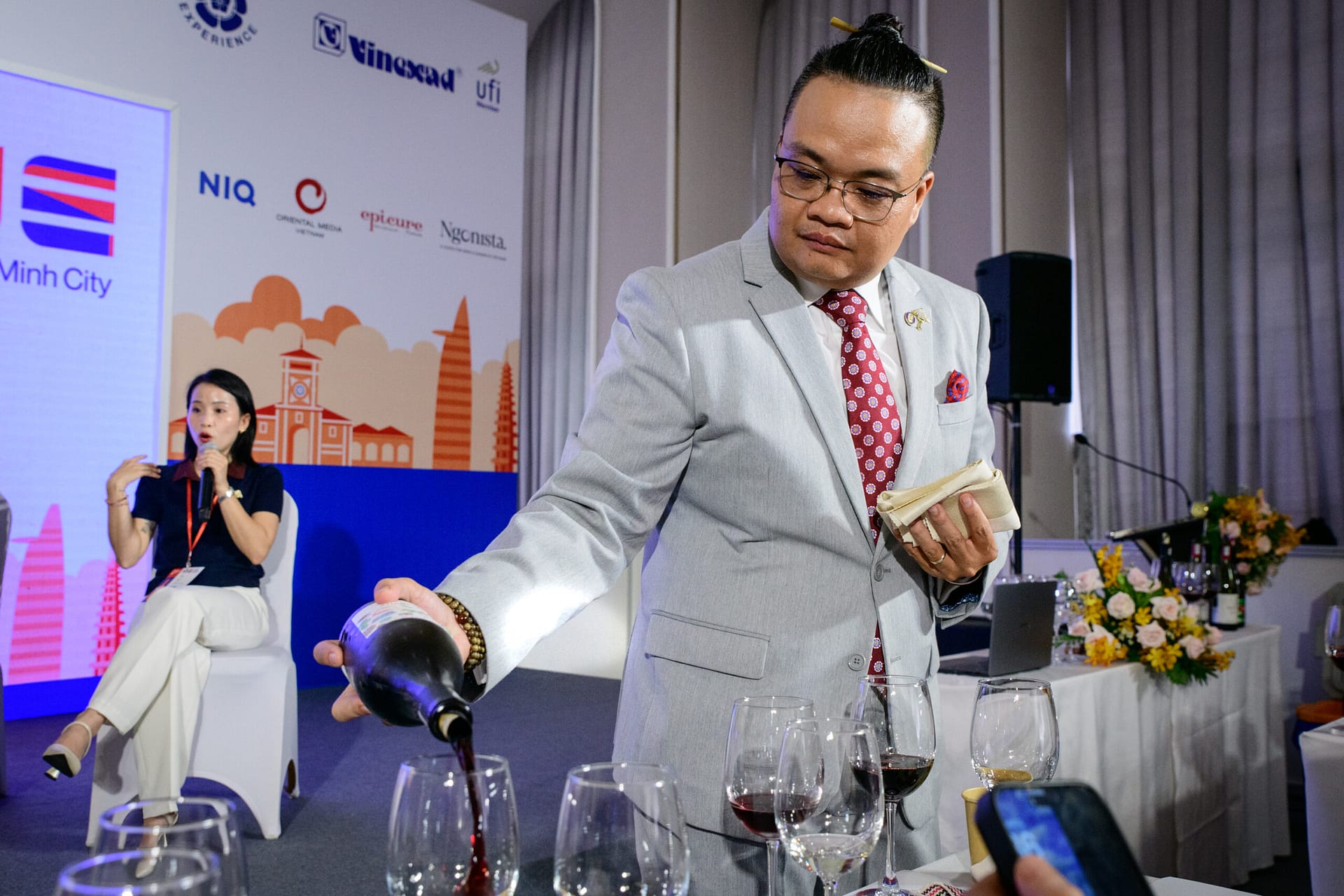
Mmmm…Enjoy, Prosecco Extra-dry Millesimato
Presented by Trâm Tran. The label alone does the work first: deliberately playful and contemporary, what Trâm called “so modern, like Gen Z.”She described it as having “very good acidity, refreshing, and beautiful fruit aroma on the front” – and made an immediate case for its versatility with Asian food: “I think about it as very matching with Vietnamese food, or Asian food in general.” Crisp, light, a natural fit for brunch, casual meals, and spicy dishes.
Tenuta delle Terre Nere, Etna Rosso (Mt. Etna, Sicily)
Presented by Happy Gan. The evening before the panel, Happy blind-tasted this wine with colleagues and thought it was a Nebbiolo – fooled by its very refined tannins. “Because of the altitude, it gives the wine very good freshness, very good acidity,” she said. “You’ve got the fruits and at the same time, you get the freshness – it shows a lot of balance.” On the palate: soft, well-structured, with a small spicy note. Etna is still an active volcano and she argued that young consumers want exactly that kind of story – “young people are talking a lot about this tiny and very beautiful area” – and that the wine is still hard enough to find that discovering it feels like something.
Varvaglione, Susumaniello (Puglia, Italy)
Presented by Minyoung Ryu. Minyoung first encountered this wine a few months earlier at a brand launch in Bali. Her initial reaction was to tell the sales manager Bali was already heavily stocked with Puglian wine. “I started tasting it, and then I really loved it” – she now sells it at her venue. The Susumaniello grape is a Puglian variety with low international export volumes, but Minyoung argues it has the profile to travel. “Medium-bodied, not too difficult, light tannins” – approachable enough for a range of contexts. “Whenever the guests feel that this is going to work for the food, they don’t mind” what the label says. The variety, the region, none of it matters if the wine works at the table. And this one does: “very good for international food,” she said.
Paltrinieri, ‘Solco’, Emilia Romagna – Lambrusco Salamino
That morning, Apple had spoken with the producer and she learned that Paltrinieri was in its centennial year. She walked the audience through the three main Lambrusco clones: Grasparossa, Sorbara, and Salamino. Sorbara is the lightest of the three and the most delicate, Grasparossa is the fullest-bodied, richer and with heavier tannins, and Salamino is typically more medium-bodied and takes its name from the shape of its grape clusters, which resemble a small salami. “The taste is quite subtle,” she said. “It looks dark but it’s not tannic – very refreshing, with a creamy texture.” Then she put a question to the room: guess the residual sugar. Answers came in between 4 and 8 grams per litre, whereas the actual figure was 20. “You get the balance of flavours and everything in the glass,” Apple said. At 11% alcohol and built for Asian food pairings, it landed as a near-perfect illustration of the lighter, lower-alcohol direction the whole panel had been predicting.
CELLAR BRIDGE | cellarbridge.com | editor@cellarbridge.com | Words & Photography by Aurélien Foucault