
Words & Photography by Aurélien Foucault
Panel report:
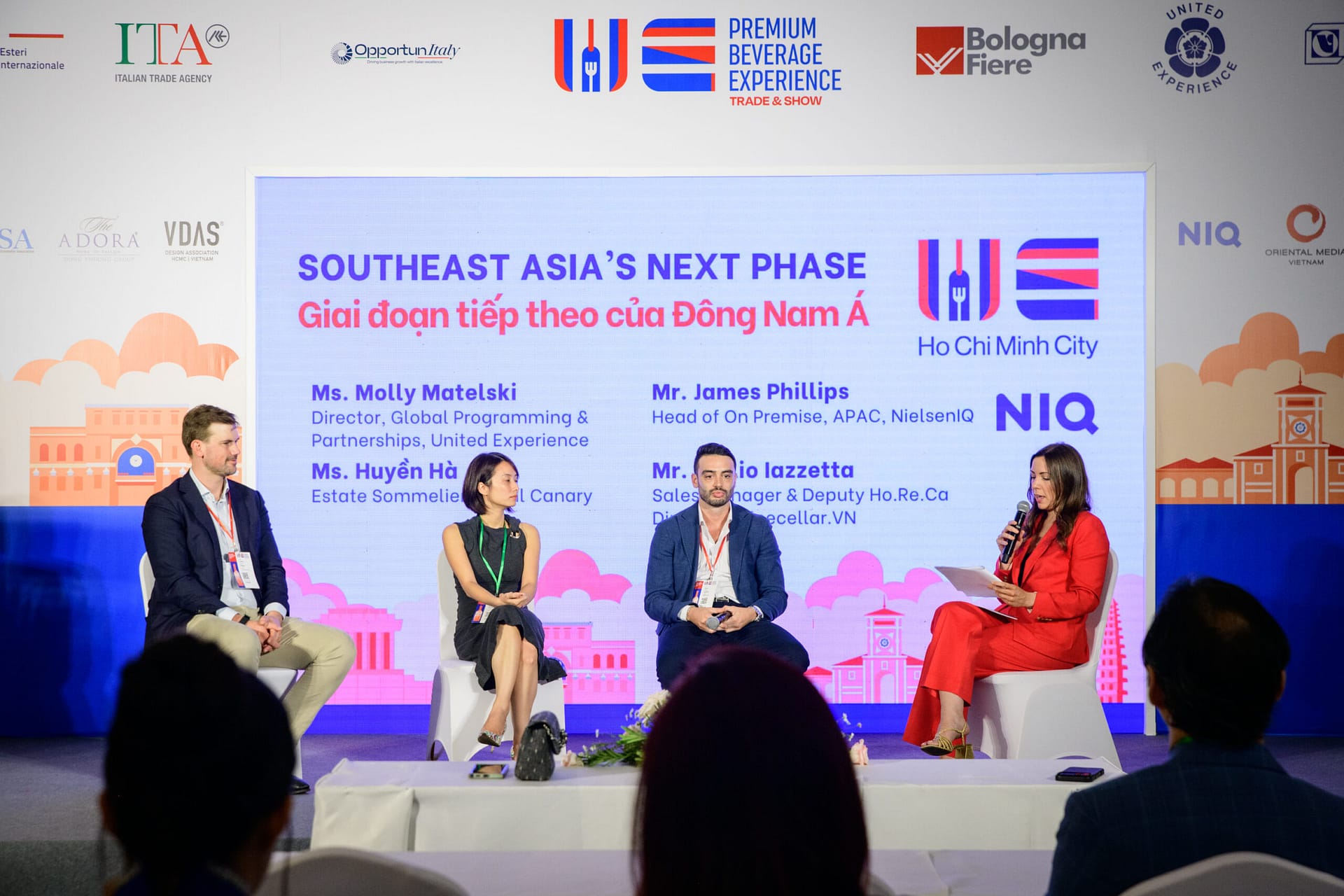
Wines Experience HCMC 2026 – Southeast Asia’s Next Phase – 25 June 2026, , The ADORA Center, Ho Chi Minh City
Moderated by Molly Matelski (United Experience), with James Phillips (NielsenIQ), Giulio Iazzetta (WineCellar.vn), Ms. Huyền Hà (Estate Sommelier, Royal Canary)
On June 25th, at the opening day of Wines Experience in Ho Chi Minh City, a NielsenIQ-supported panel took on an ambitious question: what comes next for Southeast Asia’s hospitality and wine markets? Held in the large hall of The ADORA Center before an audience made up largely of industry peers, the discussion offered a data-led but grounded look at a region whose drinking habits, spending patterns and hospitality culture are evolving quickly.
The panel brought together three voices with very different vantage points on the same market. James Phillips, Head of On-Premise for Asia-Pacific at NielsenIQ, presented findings from the company’s OPUS survey, which covers five Southeast Asian markets and tracks more than 2,000 on-premise consumers in Vietnam alone. Giulio Iazzetta, Sales Manager and Deputy HoReCa Director at WineCellar.vn, brought seven years of ground-level experience distributing Italian wine across the city’s restaurants and hotels. Huyền Hà, formerly Head Sommelier at the Michelin-starred Saigon restaurant Akuna and now Estate Sommelier at Royal Canary, stands between the importer and the table: the person who helps decide what bottles actually get opened.

The Data
Phillips built his picture from the macro down. Vietnam sits near the top of GDP growth projections in Southeast Asia – the government has set a target of above 10% GDP growth for 2026 – and, he argued, that growth is structural rather than cyclical, driven by foreign investment in industrial and capital markets, and by a long-term demographic shift moving more of the population into the middle class. The on-premise momentum follows from that: NielsenIQ’s OPUS data places Vietnam at the top of its charts for both expected income growth and expected frequency of out-of-home spending. Phillips called Vietnam “one of the key vibrant markets we’re seeing not only in Asia-Pacific but globally.”
However, there are serious caveats worth noting. Alcohol taxation is increasing across Southeast Asia, and Phillips flagged it as a variable with real long-term implications for wine consumption. FMCG (fast-moving consumer goods) volumes in Vietnam were down through most of 2025, though Q1 2026 brought a recovery: 4.3% value growth, coming through both price and volume. Inflationary pressure pushed some consumers back toward cheaper categories in the short term, domestic beer first among them. Beer remains the dominant beverage in the Vietnamese on-premise by a considerable margin.
The wine-specific findings were among the most revealing.
In terms of geography, wine preferences in Southeast Asia vary significantly. In Singapore, for example, red wine dominates, accounting for 63% of wine sales by value, though its value fell 5.6% year-on-year while white wine grew 4.6%. Vietnamese on-premise consumers, on the other hand, favour white wine and rosé more than their counterparts elsewhere in the region, and they spend more on premium whites than on premium reds. While the premium wine segment in most Southeast Asian markets is led by red wines, Vietnam bucks the trend, with premium white and sparkling wines taking precedence. Italian wines have also performed strongly, with NielsenIQ’s retail data showing a 9.3% increase in value in Singapore over the past year, making them one of the fastest-growing origins in the region.
On the white wine trend in Vietnam specifically: white wine increased its share of total Vietnamese wine consumption by nearly 9% between 2023 and 2024. The premium white styles gaining the most traction include white Burgundy, Riesling and Pinot Gris. However, to be realistic it’s important to understand that wine as a whole still accounts for less than 1% of total alcohol consumed in the country.
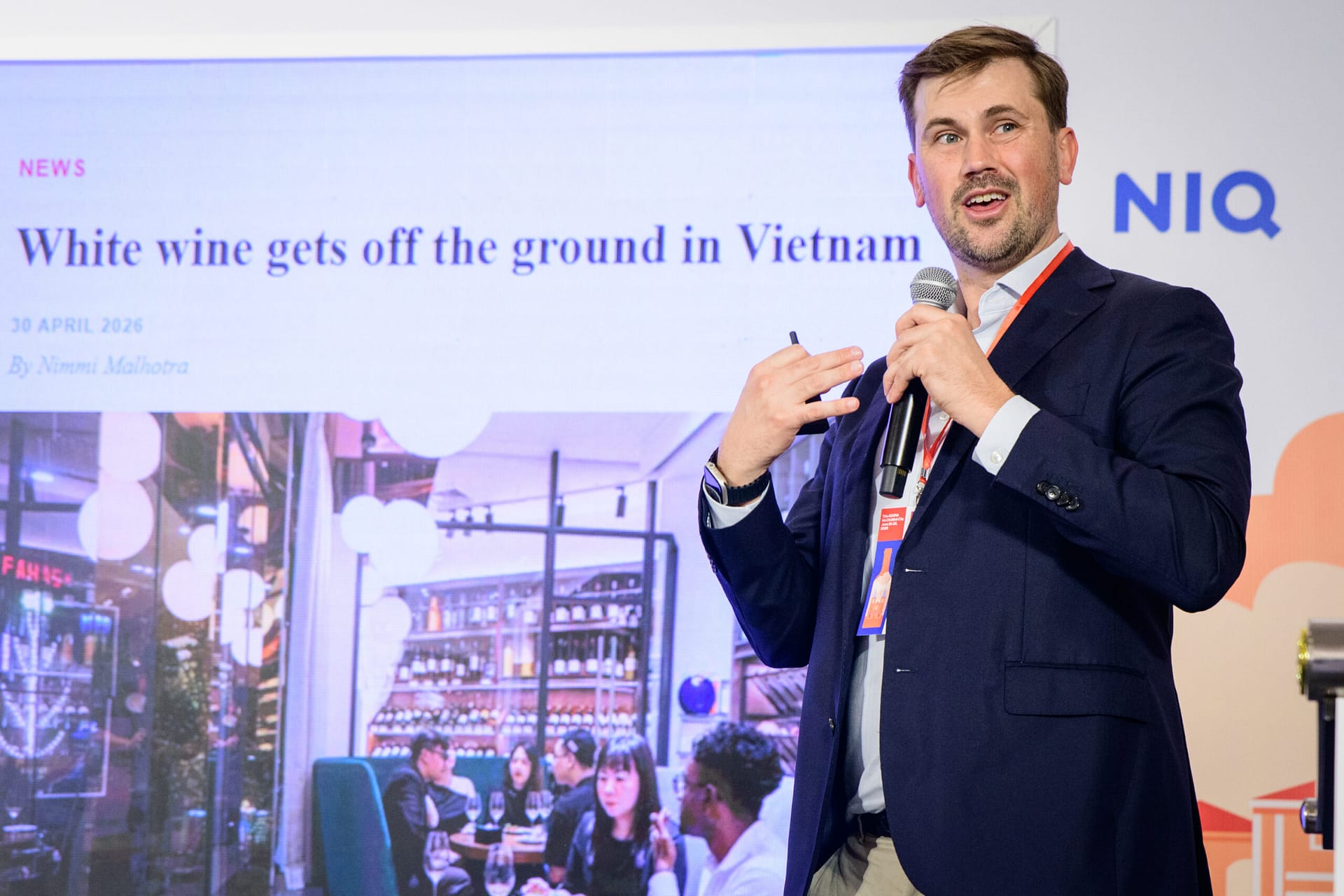
The second finding concerned who Vietnam’s wine consumers actually are – and what they do when they go out. The core on-premise wine drinker skews toward the 35-44 age bracket, slightly older than the broader on-premise average. Vietnamese on-premise consumers have an average of 3.3 drink categories in their repertoire, 0.3 above the Southeast Asian average. They visit bars and restaurants less frequently than beer drinkers. But when they do go out, they spend more per occasion than any other beverage category, including cocktail drinkers, and allocate a higher percentage of their disposable income to hospitality than anyone else in the survey. The Vietnamese wine consumer is not a volume buyer. They are a value buyer, with more per-occasion budget than any other group.
The outlook among younger consumers is more dynamic. Generation Z leads the way as the highest-spending group in on-premise venues, visiting bars and restaurants more frequently than any other demographic and actively setting the pace for emerging trends. NielsenIQ data shows that twice as many Vietnamese consumers plan to drink cocktails more frequently over the next 12 months than plan to do the same for wine. Their connection with wine is still evolving. As Phillips emphasised, “Engaging younger consumers, exploring new formats, varietals, and serving styles is absolutely vital.” He also remarked that older consumers across Southeast Asia are gradually moving away from wine – not abruptly, but steadily – as boundaries between beverage categories become less distinct and the price difference between wine and cocktails continues to shrink.
Giulio’s Ground
Giulio Iazzetta came to Vietnam from Italy seven years ago and has spent six of them with WineCellar.vn, one of the city’s largest Italian wine importers, working the HoReCa circuit that runs from luxury hotels down through the mid-range restaurant trade.
On regional differences within Vietnam, Iazzetta said Hanoi retains a strong gifting culture around wine, particularly around Tết. Da Nang, expanding rapidly on the back of coastal tourism, is showing the highest demand for whites, sparkling wines and rosé – something that tracks with a city whose hospitality economy runs largely on international visitors and weekenders from the south. Ho Chi Minh City is more layered, and more varied in what the market absorbs.
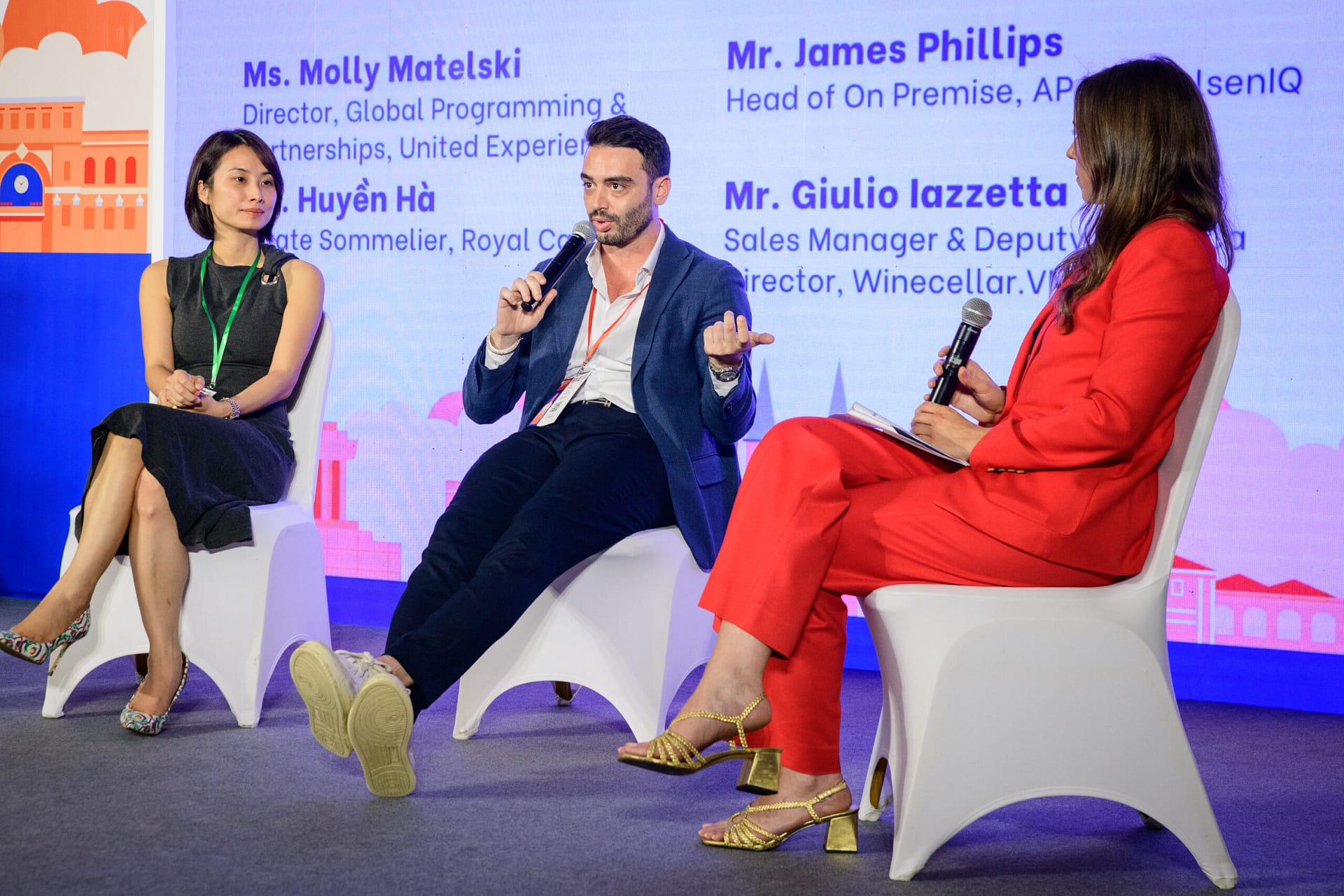
On portfolio evolution, WineCellar has been moving away from what Iazzetta described as “heavy bottle” wines – the thick-glass prestige formats that once signalled value by weight. Vietnamese consumers increasingly read quality through what is in the glass rather than the heft of the container. “We used to have a lot of Negroamaro,” he said, by way of example. “We are importing more Montepulciano now. There is more appreciation for quality in the wine.” He was positive about this clear this development: “The market keeps developing. Young people are very curious and they want to explore new things.”
On the Michelin Guide, which arrived in Vietnam recently, Iazzetta called it a catalyst for change because it “gives a mission to young guys and girls working in F&B,” he said. “It pushes them to reach the next level.” The sommeliers being pushed are, in turn, pushing the market – something Huyền Hà, sitting next to him on stage, could speak to directly.
Phillips added the social media dimension: NielsenIQ data from across Southeast Asia shows that on-premise consumers increasingly say a visit “didn’t happen unless I posted it on social media.” The way a wine shows up in a photograph matters now. “The way the wine shows up, not only in the bottle but in the glass, is really important,” Phillips said. That point also reinforces the idea that Bordeaux-style labels need a good dust-off, and that creativity in labels and design is more important than ever.
The ‘One Word’ Challenge
To conclude the panel, Molly asked each panelist what single word would most define Southeast Asia’s next phase over the next three years.
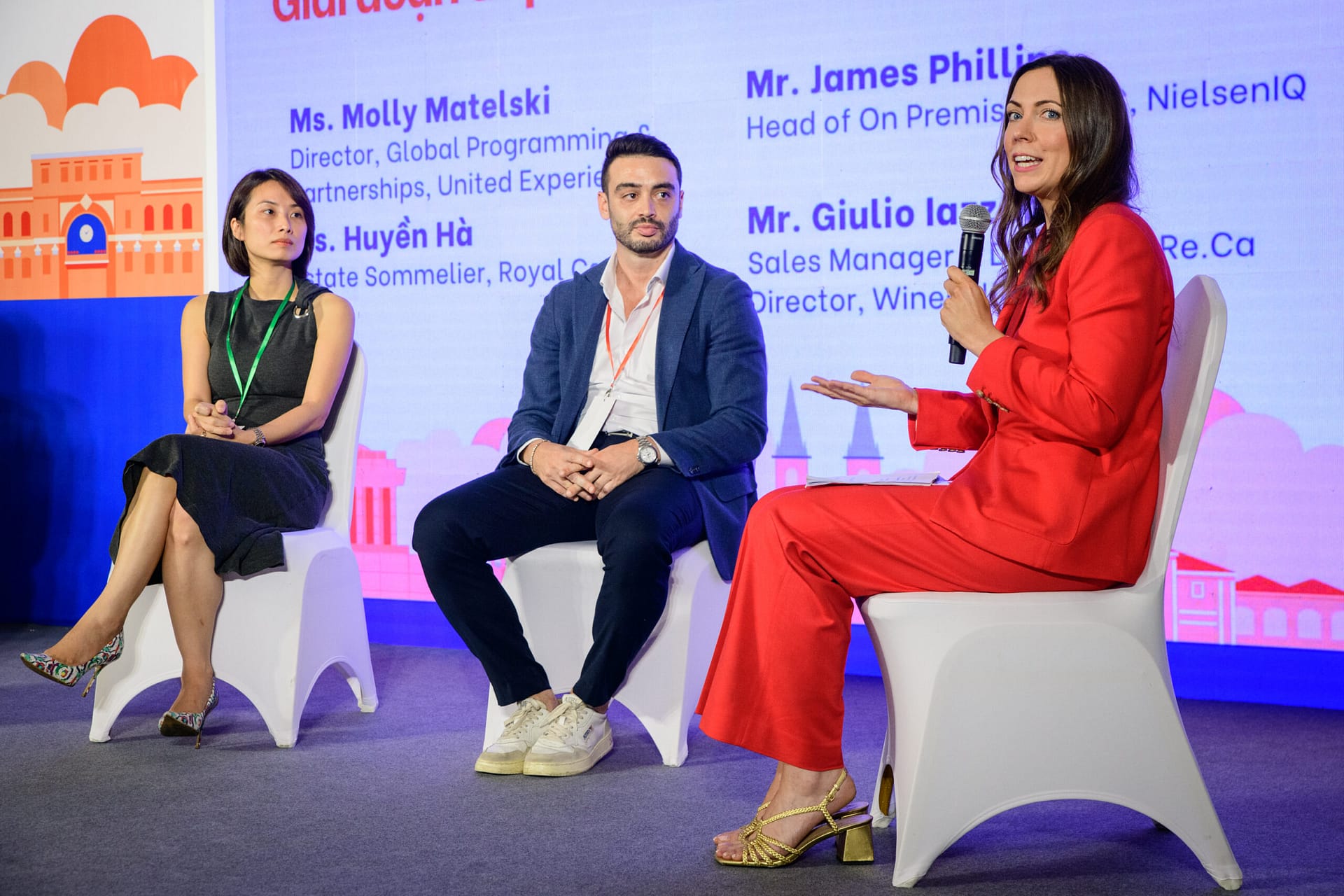
For Phillips, it was “Vibrancy” – specifically, the way the on-premise consumption window is moving faster across the region. “Consumption occasions in on-premise come earlier and earlier,” he said. “And if you’re out in that kind of climate here in Vietnam, it’s a refreshment occasion.” That is where wine currently struggles. Beer is cheap and ubiquitous. Cocktails have closed the price gap. The spritz and aperitivo formats are where wine is winning the refreshment occasion, he argued, and Campari’s recent investment across Southeast Asia on exactly this occasion is not accidental. “In the future we’ll see more and more of this kind of light refreshment serve style,” he said, describing a future of increasingly blurred category lines.

Iazzetta connected his word, “Digitalization” to education, and said the two will increasingly work in tandem. The gap he described is real: when there is no sommelier at the table, and the consumer cannot navigate a wine list alone, the default is familiarity – usually a grape they know, a label they recognise, or a price point that feels safe. Digital tools that can bridge that gap, in the restaurant, at the shop or online, will allow importers and producers to reach consumers they currently cannot. “I’m not saying it’s going to replace someone,” he said of technology, “but support the consumer to choose what’s best for them for their specific occasion.”
For Huyền Hà, it was “Sophistication” – by which she meant that consumers are gaining knowledge, asking sharper questions and showing a greater willingness to spend on experience rather than prestige alone.
“For the next three years, I believe that consumers won’t ask you what is the famous bottle. They will ask you what is going behind the bottle, why it was suggested to them and why it suits the occasion. So it’s not about selling the bottle anymore. It’s about what experience you bring to the table.”
Huyền Hà, Estate Sommelier, Royal Canary
This is, in essence, a reflection of what wine still has to offer to many consumers who are only beginning to discover it: the depth of wine culture, from grape varieties to soils, traditions and methods, and the people who turn fruit juice into our favourite beverage.
Whether the industry can build the structures to tell those stories at scale, in a market changing faster than many of its suppliers, is what the next three years will answer.
And that, certainly, is part of our mission here at Cellar Bridge Magazine.
CELLAR BRIDGE | cellarbridge.com | editor@cellarbridge.com | Words & Photography by Aurélien Foucault