
THE TALK
presents
Timo Mayer,
Winemaker
Interview & Photography by Aurélien Foucault
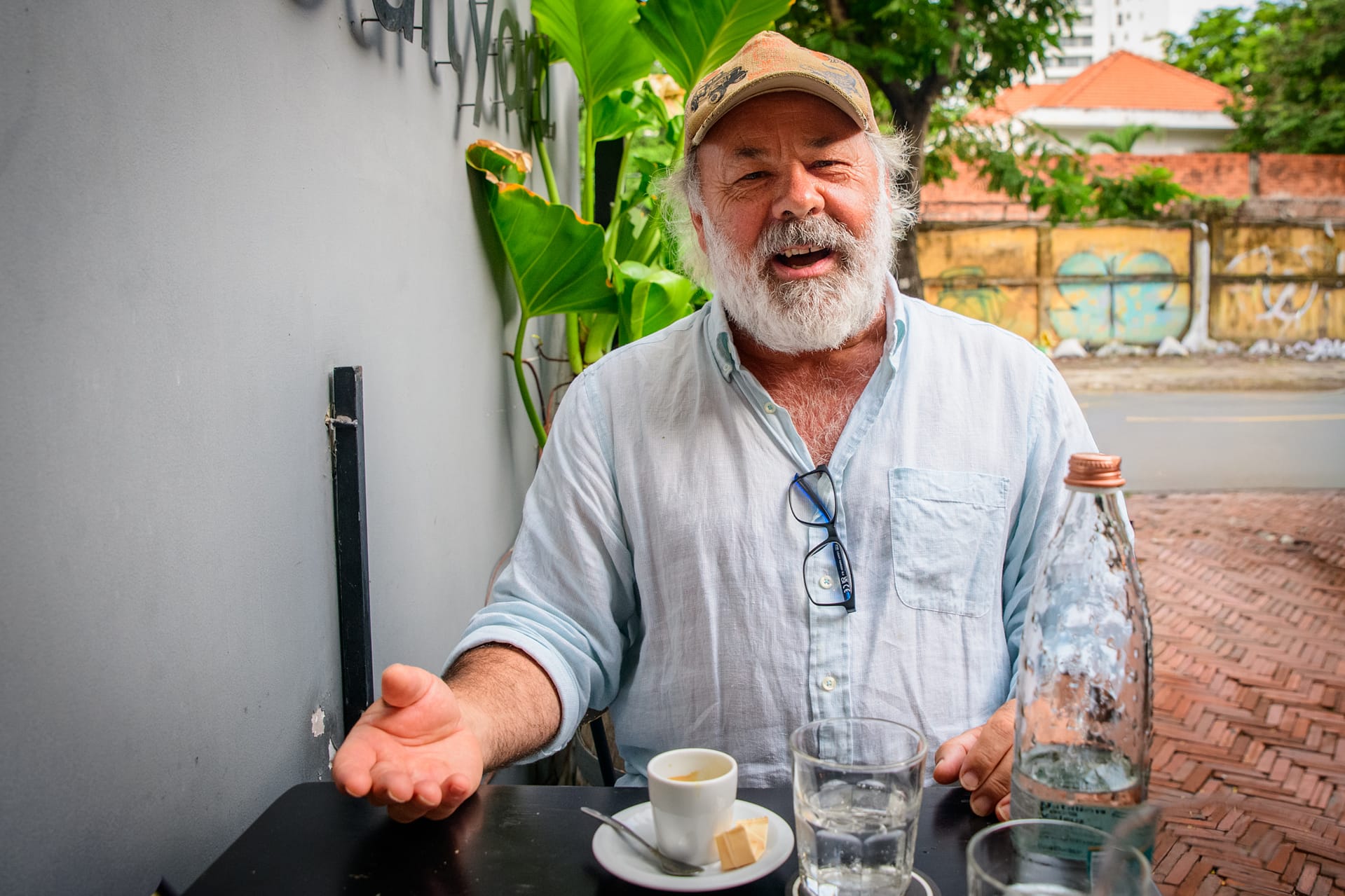
Timo Mayer – born into a Württemberg vigneron family, founder of Mayer Wines, and planter of the steep Bloody Hill vineyard in the Yarra Valley – is a leading voice for low‑intervention, cool‑climate wines and whole‑bunch ferments.
The opinionated winemaker was in Ho Chi Minh City to visit their distributor Enoteca and head a fancy wine dinner at MAD Wine Bar.
We couldn’t miss the occasion to ask Timo a few questions and learn about the man behind the brand.
Cellar Bridge: Is this your first time in Ho Chi Minh City?
Timo Mayer: The last time I was here was 22 years ago, when I came as a backpacker with my family – my wife and three kids in tow. We spent a month travelling through Vietnam, flying into Saigon and departing from Hanoi. We only brought a small bag with us, about three undies each and toothbrushes. It was very different, none of these bars were around back then.
CB: What’s your earliest memory in connection with wine?
TM: Well, my family are vignerons. The vintage time was the highlight of the year. We had crackers, we called them “Knallkörper” – little Chinese firecrackers. So with the kids we’d always play with them and scare the birds away during the harvest. It was always funny.
CB: Can you tell our readers a bit about your story and how you came to winemaking?
TM: I left Germany when I was 21, to go to America. My family were vignerons but I didn’t want to do this. My brother kind of took over the family estate, and I left.
In 1987 I went to America. I met Rhonda there – she’s a Melbourne girl – and we lived in America for four years, down in the Florida Keys. We met in Key West Florida, you know, seasonal work, work in winter, holiday, backpacking in summer, you know, just going all over the place. We did that for four years and then in ’91 we migrated to Australia and we moved up to Cairns. Cairns is kind of the same lifestyle as Key West: tourism, diving, sailing, hospitals, all that. I worked in hospitals. I’m originally a motor mechanic. Back in Germany I did an apprenticeship as a motor mechanic before I left.
Then I got into hospitality, started washing dishes, worked my way up the line to be the head chef. For 6 years I worked in kitchens and cooking. And then we started breeding, we were living up in Cairns and we had our son Rivar. We said “shit, now we gotta work”. And that’s when I started Enology in Australia, in 1995. Rivar was born in 1993. So then it was literally, “Well, I know how to drive tractors and drive up the vines, and other things… I’ve done that before. Let’s make it a career!” So that’s when I started working in ’96 in the Yarra Valley, because Rhonda wanted to be near Melbourne. We had Rivar, family, grandma, grandpa, cousins, aunties and all that. I didn’t have any family there, so at least we used her side of the family.
We had to find a home, do something, for the next 25 years. And then we could give it all away and start backpacking again. That’s kind of what it was to us. Winemaking is a job for me.
We did really well, considering we were first generation vignerons in the Yarra Valley. Selling wine in 20 countries around the world, out of nowhere, out of nothing.
We built our home, built our winery, we were lucky enough, we had the right time, the right place, we did really well, considering we were first generation vignerons in the Yarra Valley. Selling wine in 20 countries around the world, out of nowhere, out of nothing. We never asked the kids to join us. Rivar studied a master of Geomatics, for six years. We were: Kids, do what you want to do, we did our thing – you do yours. I didn’t want to do what my parents did, I got as far away as I could. And Rivar finished uni, and said: “Dad, I want to be a winemaker.”
So now with Rivar*, Rhonda and Ivy, the youngest one, and between the four of us, we make it work.
CB: I’ve read a lot about the fact that you put the whole bunch in, but what about the agriculture itself?
TM: Well, we try to be organic as much as we can. We were organic for like 4 years, in the dry years. But then in 2021 the rains came and we had to use systemic fungicide, phosphoric acid, which used to be organic & biodynamically allowed but they took it off the list ten years ago. Actually, they’re talking about bringing it back in Europe, because a lot of wet regions can’t make grape without it. You know, there’s no point being organic if you can’t produce grape. So my philosophy is yes to organic, but at the end of the day, I want a grape. So our biggest challenge is downy mildew in springtime. If that starts in the early growth, you get those oil spots, and when that goes on the flowers, you lose your crop. So before flowering, when we have all the oil spots, I put a phosphoric acid to protect the crop.
CB: What drew you to whole bunch in the first place?
TM: I’ve always had this thing for whole bunch. I like Beaujolais – Foillard and Marcel Lapierre. How good is Foillard?! Those were my eye-openers.
CB: So you grew up drinking those wines?
When I grew up, oak was a fault.
If you could taste oak in a wine, you had failed.
TM: No, no. When I grew up, we were drinking Trollinger, Spätburgunder, Portugieser – the local German stuff. When I came to Australia, the first wines I got into were the big ones – d’Arenberg from McLaren Vale, the Ovens Valley wines. Quite full, but not oak-fucked. Really fruity and big. I always hated oak. That’s my number one enemy. When I grew up, oak was a fault. If you could taste oak in a wine, you had failed. That’s always been my view.
In the 90s, everyone was making wine for America, for Parker. Oak was everywhere. And I thought: this is wrong. This is not what I want to drink.
I was working at de Bortoli, and we had this one wine – a second-tier Yarra Valley thing, nobody gave a shit about it. Higher crop, so lower alcohol, maybe 13%. It never saw new oak, just went into old barrels, only pumped over twice a day instead of four times. And at the end of vintage, you’d walk through the cellar and taste the flagship wines – undrinkable. Then you’d try this ugly duckling, and it was the most aromatic, beautiful wine. I thought: that’s it. That’s the Yarra Valley. Why don’t we just make that? Yarra Valley is medium-bodied. Let’s stick with it.
CB: And you weren’t the only one thinking that?
TM: There was a whole group of us – Luke Lambert, William Downey, Sandro Mosele from Mornington, Serrat, Mac Forbes. We all had our little niche. Mac picks early. I do whole bunch. But we all had one philosophy: no new oak. We want to taste the grape, the vintage, and the terroir.
CB: What about Chardonnay – no oak there either?
If I can’t sell it, I’m going to drink it myself – so it might as well be something I enjoy.
TM: The Antichrist. Don’t start me. I drink Sancerre, Chablis, Chenin Blanc – anything that’s crisp, dry, and white. And that’s the style we make, because that’s what I want to drink. If I can’t sell it, I’m going to drink it myself – so it might as well be something I enjoy.
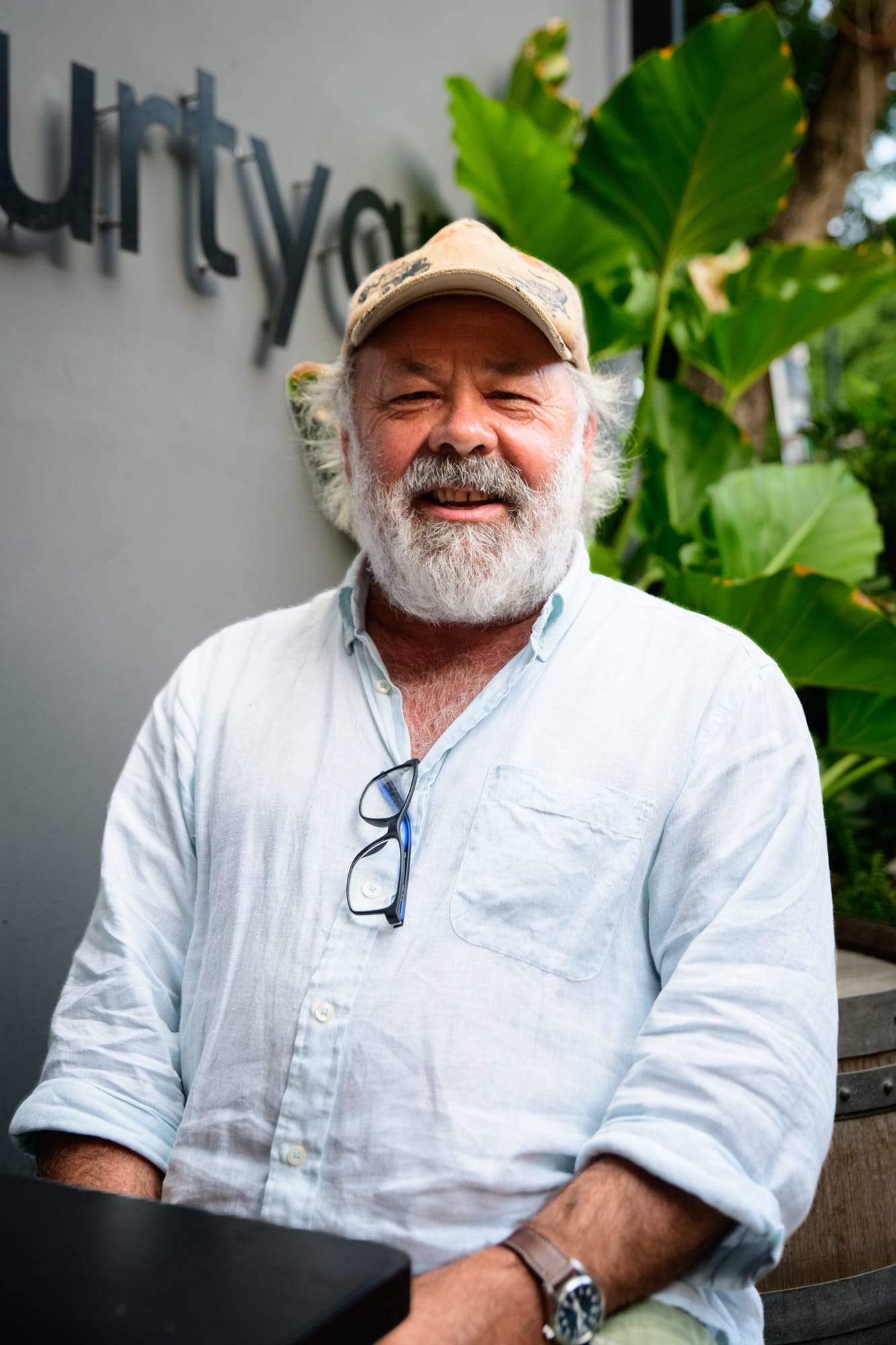
CB: Your slogan is “bring back the funk.” Define your vision of “Funk” for us.
TM: When we started out in the 90s, all Australian wines had to go through a tasting panel before you could export. The whole system was built around wine shows, and the judges only gave medals to clean wines. No reduction, no struck match, no VA (Volatile Acidity) – all classified as faults.
To me, struck match is the pinnacle of white winemaking. If I can get that in a wine, I’ve succeeded. Mercaptans, VA – in moderation, those things make a wine more complex. Every great red Burgundy has a bit of burnt rubber. Every good white Burgundy has a bit of flint. That’s what I love. But in Australia at the time, those wines got thrown out.
I had my first export to London – a Syrah with a bit of reduction. The panel in Adelaide rejected it. Said Australia couldn’t export a wine like that because it would give us a bad name. My importer loved it. It was like any other European wine.
After I jumped up and down about it, they said I could resubmit and pay again, and they might let it through. Then in the early 2000s, the whole tasting panel system got abolished. And after that, we could finally make proper wine.
CB: Wine is also about people and their stories, this is what we try to share here at Cellar Bridge Magazine. Do you have any role models or winemakers you look up to?
TM: Well, that’s my clientele, those people who want to be part of my story. They want to taste that stalky shit, what this is going on about, you know? That’s how I drink wine too. I want a Thierry Allemand, because I like his story. I like the same style of wine. I got to buy a bottle. I buy myself into his life. That’s what you pay for.
Thierry Allemand, yeah, he’s the best. Same story – he was a mechanic. He brought the old vines back. He’s got about three hectares, like us, in Northern Rhône. That’s where Auguste Clape comes from too.
CB: How big is your production?
TM: About 3,000 cases. There are enough people out there who share the same idea of style. We make what we like and we sell most of it for export: Japan, Europe, Scandinavia… everywhere.
CB: Last question – your advice for young winemakers?
TM: Don’t do what other people do. Find your niche. There’s no point competing with Mount Mary on Cabernet Sauvignon. We found whole bunch. Make wine the traditional way – that’s how it was done everywhere, Burgundy, Barolo, the Caucasus, everywhere – until Henri Jayer came along in the 1970s and made destemming fashionable. Before that, 100% whole bunch was standard.
The big companies can’t do whole bunch – it’s literally impossible at their scale. So that’s where we come in. It’s boutique, it’s small. So yeah, do stuff like that – do what you want to drink!
*Rivar Ferguson-Mayer is now a winemaker in his own-right with the Bloody Hill Villages.
Timo Mayer’s wines are distributed in Japan, Korea, Hong Kong and Vietnam through ENOTECA. Contact them for purchase.