
ProWine Tokyo 2026
A 3rd edition packed with discoveries and new horizons
Words & Photography by Aurélien Foucault

France and Germany had large pavilions with a vast offer, but I spent limited time in either. ProWine Tokyo offered access to regions that rarely get a table in Asia, and I wanted to take this opportunity to taste those wines and learn more about these lesser-known regions. To me, that was the event’s main draw: Uruguay, Serbia, Georgia, Romania and Greece, as well as Japanese wines themselves were all reasons to maximise my time there and get a chance to spend time with everyone.
I hung around the Uruguay’s pavilion slightly longer, so they will be featured in a separate article. Here are some of my notes on ProWine Tokyo 2026.

THE NO-LOW PRODUCTS
As the industry keeps repeating: the market is moving towards no or low alcohol drinks, and ProWine played the game with a ZERO corner, that had on offer a large array of sparkling de-alcoholised ‘wines’.
I’ll be honest – I have zero interest in de-alcoholised wine.
Stripping alcohol from a finished wine makes absolutely no sense to me. It’s heavy on energy-consumption, and somehow makes a circus of a process whose goal was simply to transform grape juice into alcohol – and turns it upside down. It’s akin to making tobacco-free cigarettes for people who don’t smoke : pointless.
However, I have more interest in people working hard at creating other products, that taste good and show character, while having a certain class; thus offering the possibility to accompany non-drinkers at the dining table, without making them feel like teenagers. That reminds me of a time when I worked at a wine bar and a customer thanked me emphatically for giving her a wine glass to drink her soda, so she wouldn’t look too different from the crowd or feel infantilized with a colourful can and a straw.
One of these more innovative products that have been gaining momentum are the sparkling teas, and I’ve tasted two interesting propositions at ProWine Tokyo.
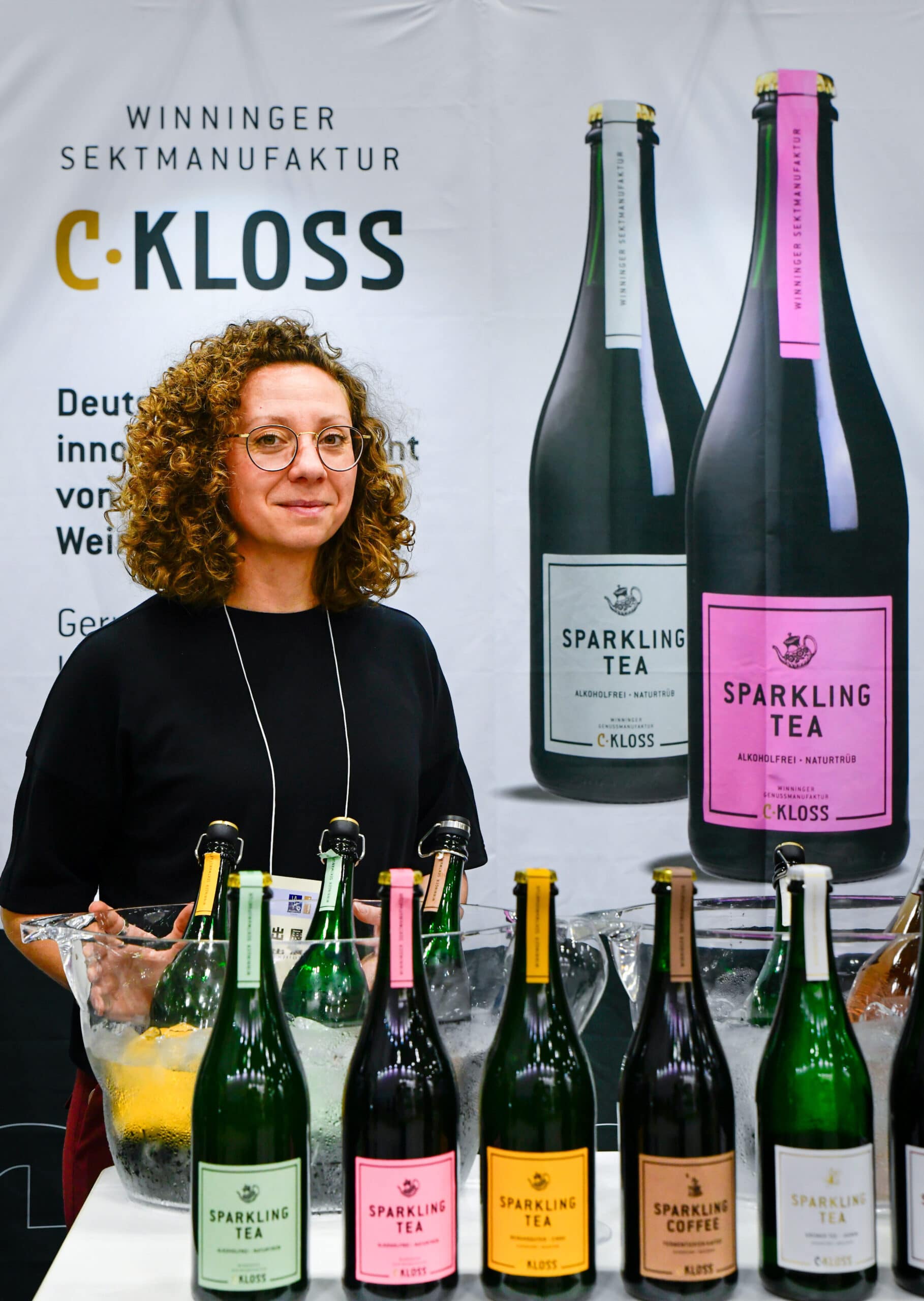
The first was C-Kloss, a producer from Winningen on the Mosel. Christian Kloss — great-great-grandson of Julius Kloss, who co-founded one of Germany’s first sparkling wine houses, Kloss & Foerster, founded in 1856 in Freyburg an der Unstrut (today part of the Rotkäppchen-Mumm group) — started this operation at the end of 2022, taking over the old Sektkellerei von Canal. Their Sparkling Teas are built on a completely different logic to dealcoholized wine: they are made entirely from fermented regional ingredients — Central European herbs, fruits, vegetables, and even kombucha — and have never involved alcohol at all. They have a relatively low sugar content (30 to 40 grams per litre, sourced entirely from the ingredients themselves), no synthetic preservatives, and won a Falstaff price-quality award in 2024.
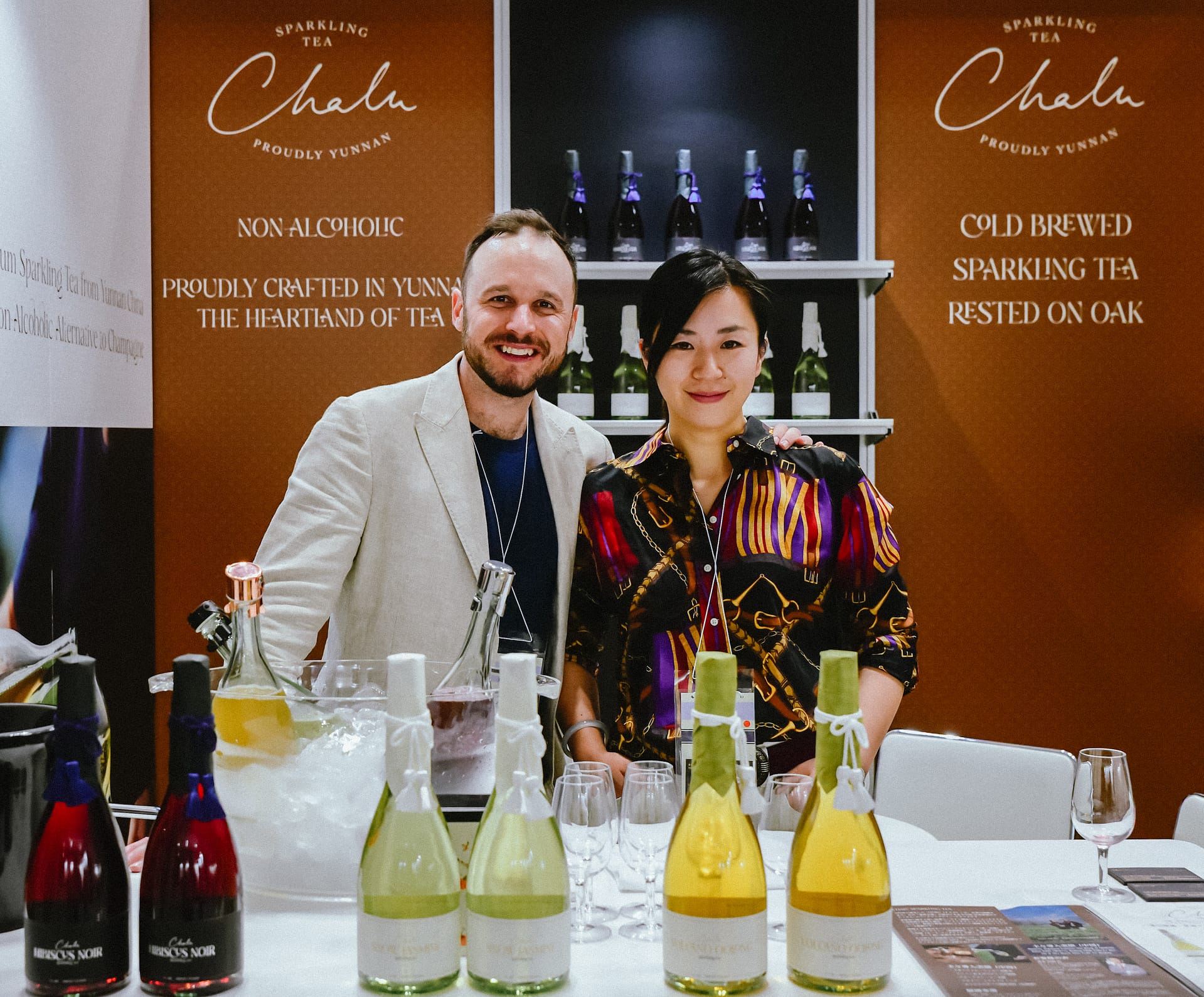
Snow Jasmine is infused at ambient temperature 7 times with a 1:1 ratio of tea and fresh jasmine flowers, in a process they call ‘scenting’.
The Volcano Oolong is brewed with three kinds of oolong tea (Green, golden and black) and it offers structure and complexity that make it truly shine on its own terms. This is a bottle I would seriously consider – and certainly enjoy way more than half the sparkling wines you get by the glass around town.
These are drinks built from the terroir of one of the world’s oldest and most distinctive tea regions, and it expresses true personality. Chalu is already being served at two Michelin-starred restaurants in Beijing and is a product worth watching closely, particularly in markets where quality tea culture is more prevalent.
SERBIAN WINES
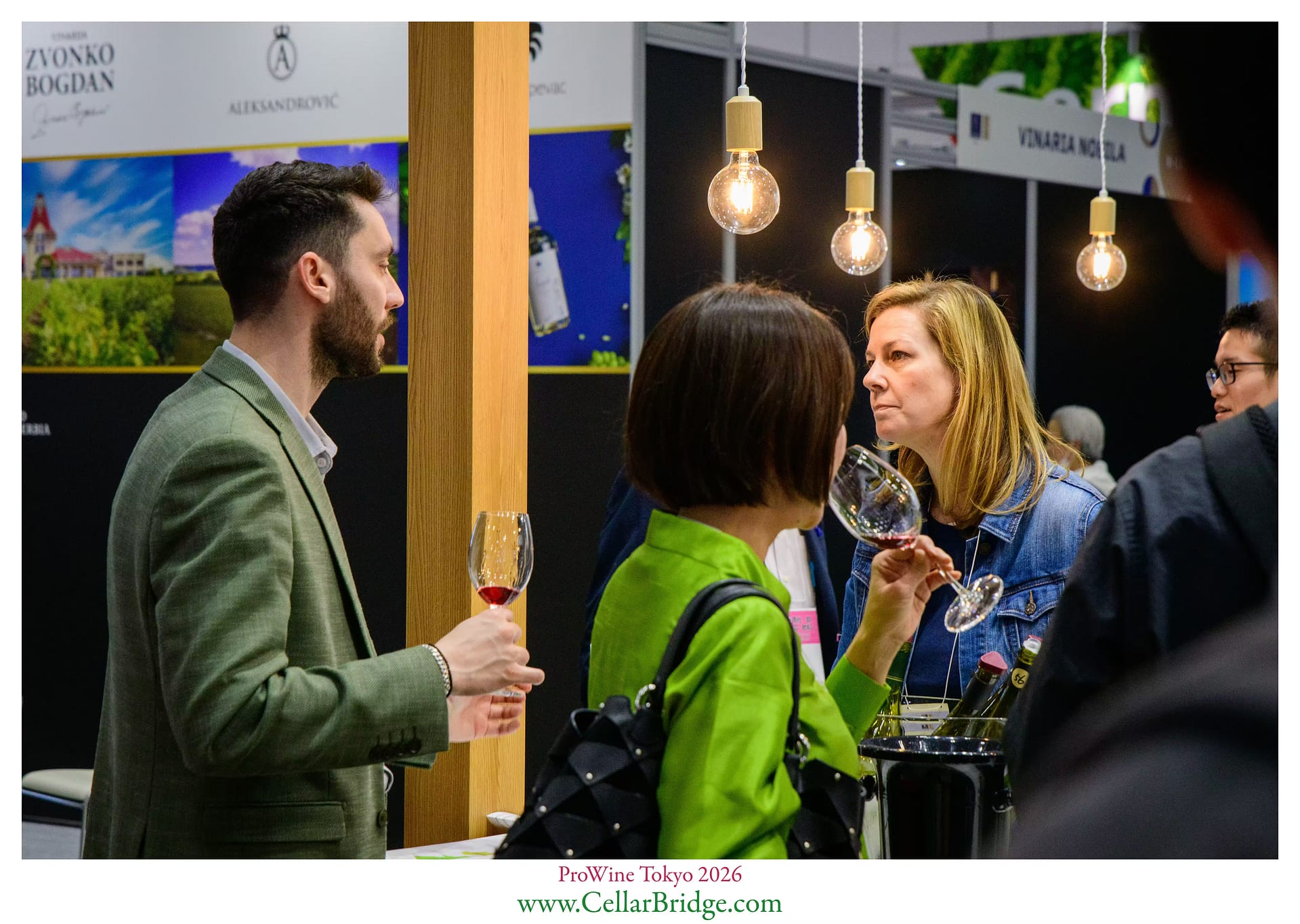
The Serbian pavilion offered a large assortment of what Serbia had to offer, both in terms of wines and spirits. There was a cheerful energy going around, with six producers sharing their large centerpiece stand and it was a good place to spend time.

Some people see Serbia as an ‘emerging’ wine country, while it’s actually part of the Old World and they’ve been doing wine for centuries. But there’s a reason why and it’s important to understand the context of wine-making in the countries of former Yugoslavia.
Under Tito’s leadership, the wine industry was fully collectivised – grape growers were obliged to sell their harvest to state cooperatives by the kilo at government-set prices, personal production was shut down, and priority was given to quantity over quality. Yugoslavia began unwinding collectivisation after Tito’s split with Stalin, formally abandoning it in 1953, but state wineries kept their grip well beyond that. It was only in the 1990s, after the fall of communism, that private winemaking became legal again – meaning the family-owned, quality-driven estates are, in Serbia, barely a generation old.
Lastar Winery is a beautiful example of what could be achieved in such time. Founded in 2013 in the Levač region of central Serbia, they make an excellent argument for Serbian Chardonnay and Pinot Noir. The Levač sits in southern Šumadija and its continental climate – with cool air currents from Mount Juhor – puts it in territory comparable to the warmer end of Burgundy’s Mâconnais. Lastar has 32 hectares, old Pinot Noir vines from 1976 which provided the backbone of their early releases, and a first Mundus Vini award in 2016 for their Chardonnay. Their Pinot Sofijin Izbor holds the distinction of being the highest-rated Serbian Pinot Noir in Decanter’s history of evaluating the country. The infrastructure is high-end: gravity-flow winery, French barrique and Hungarian oak, rigorous green harvesting – this is a site with great potential.
BT Winery, from Beška on the slopes of Fruška Gora in Vojvodina, showed a more traditional approach and excellent endemic grapes. The winery sits on mineral-rich Pannonian sea sediment soils and runs two distinct tiers: an early-drinking line and a premium Selekcija – made exclusively from the oldest vines, aged two to four years in oak and bottled unfiltered. The Casa de Oro Prokupac was the standout, but their Tamjanika, another endemic variety with a long history in the region, is well worth a taste.
Milan Zaric, an esteemed international judge and the owner of Zaric Distillery, brought rakija. The distillery is based in Kosjerić in western Serbia, on the grounds of the old Povlen brandy house, and Milan sources fruit from around a hundred subcontractors across the country. Their pear rakija Nirvana won double gold at the WSWA Convention in Las Vegas and placed in the top ten spirits in the world at the Spirit Selection by Concours Mondial in Brussels in 2020. They produce around a million bottles annually and they tasted so fine I regretted having to spit them out as it was early in the day – and way stronger than wine.
Podrum Pevac, from the village of Cvetojevac in central Serbia, is a family operation led by founder and master distiller Aleksandar Stankovic that spans both sides of the bottle – more than twenty rakija and liqueur expressions alongside nine wine labels. Their signature piece is Zlatni Pevac, a quince brandy finished with edible 23-carat gold leaf, something that should really attract attention in the Asian market.
Zvonko Bogdan Winery takes its name from Zvonko Bogdan himself – a celebrated Serbian singer of traditional old-city songs who turns out to also be a painter, poet and, since 2008, a winemaker. With sixty-five hectares, thirteen labels, and a production of over 400,000 bottles, the winery sits on the eastern shore of Lake Palić near Subotica, in Vojvodina’s northernmost wine country, and has quietly become one of Serbia’s most decorated producers. Their Cuvée No. 1 is the only Serbian wine to have won a Decanter World Wine Awards Gold three consecutive times – in 2018, 2019 and 2021.
Aleksandrovic Winery, working 75 hectares in Oplenac near Topola, carries the longest institutional memory of anyone at the stand. The family’s connection to viticulture goes back to 1903, when great-grandfather Milios Aleksandrovic helped found the region’s first winegrowers’ cooperative. After the Second World War, the royal cellar master Zivan Tadic emigrated to Canada and, learning that the Aleksandrovic family was reviving the Oplenac tradition, sent them the original recipe for Triumph – the Serbian royal wine once served at European courts. The modern winery was built in 2000 and now produces over 300,000 bottles a year.
All these wineries certainly helped to show that even though Serbian wine is currently outside most Asian buyers’ consideration, it could very well change soon, as the quality is there and their prices are well-aligned.
ROMANIA
JAPANESE WINES
I was also very keen on learning more about Japanese wines but the few participating wineries were located at the very back of the hall and with rather unclear marking. However, judging from the number of people constantly at their booth, they drew serious interest.

Nagano region, I was particularly impressed with Domaine de Yunohara, from the Nihon Alps Wine Valley in Nagano.
Their blend of Delaware & Niagara (2025) was very refreshing, with notes of candy and fresh strawberry and clear as water – which I found slightly confusing. Finally found a way to drink wine in public without getting the stink-eye!
Their Muscat Bailey-A was also interesting, light and with hints of mango alongside the usual berry notes, it made for a very easy drinking wine, waiting to be cracked open whenever a friend visits. They also make a very fine cider, crispy and not too sweet – which is excellent.
Also from Nagano, Kyoko Hosaka presented a Delaware 2023, which showed some green fig and a touch of melon as well as a Delaware Orange 2024, with hints of ripe peach and green almonds with a nutty finish. I was less impressed with their Muscat Bailey A of 2022, which had hints of blackberries but I found too watery and lacking concentration.
Maro Wines, from Hokkaido, presented a Chardonnay 2024 which showed good acidity, and a subtle tension with a certain boldness, and they had a beautiful barrel-aged Chardonnay 2023 which offered elegance and showed freshness while still being powerful. Their Pinot Noir had hints of fresh pink plums and shone with its understated character, all in finesse and delicacy.
I was also very impressed by Kikuka Winery (Kumamoto, Kyushu), with a barrel-aged Merlot that was quite electric- with a long-lasting, refined finish and notes of black pepper. This was quite different from any Merlot I’ve tasted.
A recorded video masterclass by Jancis Robinson MW, titled The Current State of Japanese Wine, ran as part of the programme – Robinson having personally selected and assessed the wines featured, which you could taste while watching the video.
BOLD NEW YORK WINES
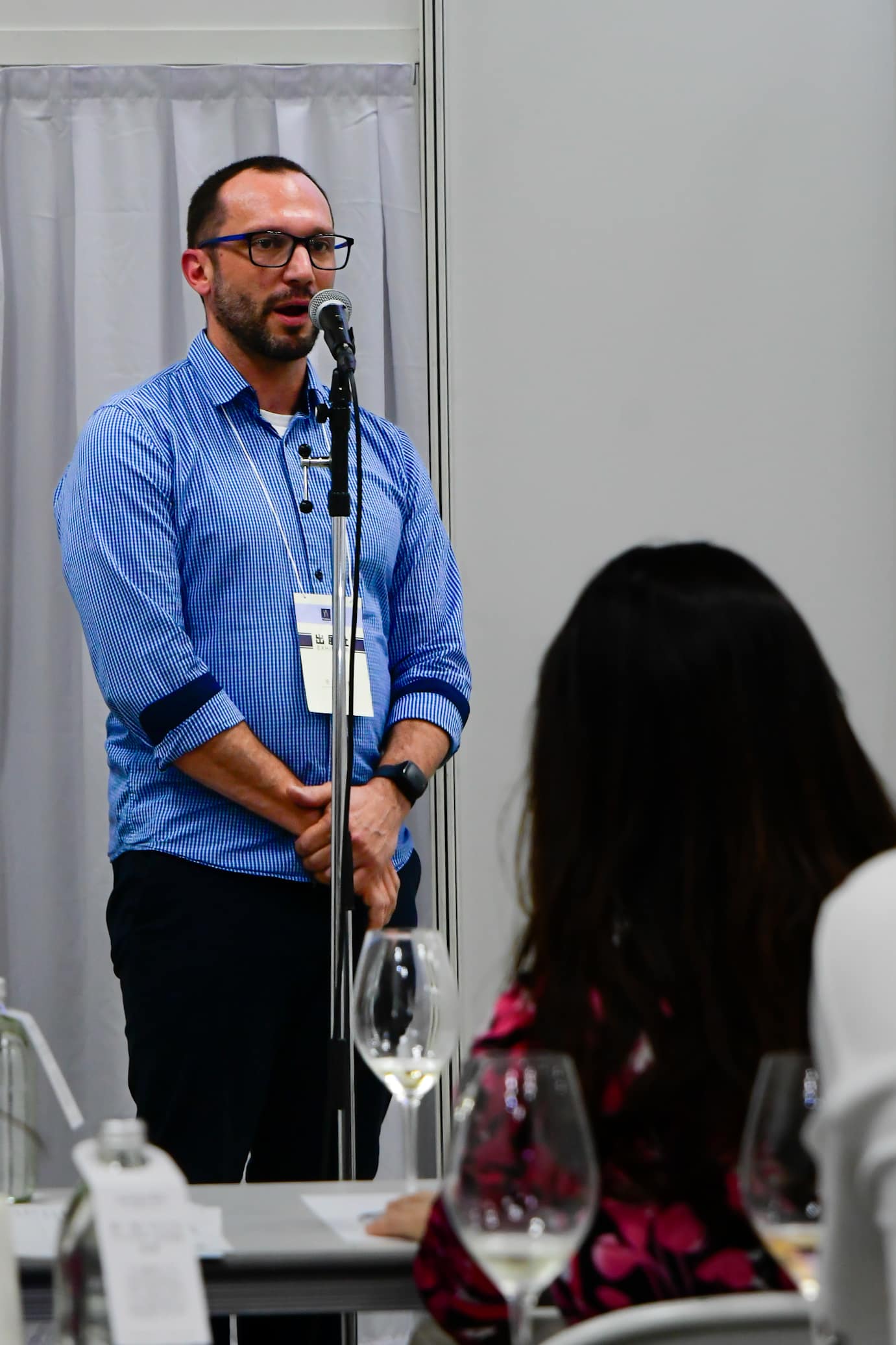
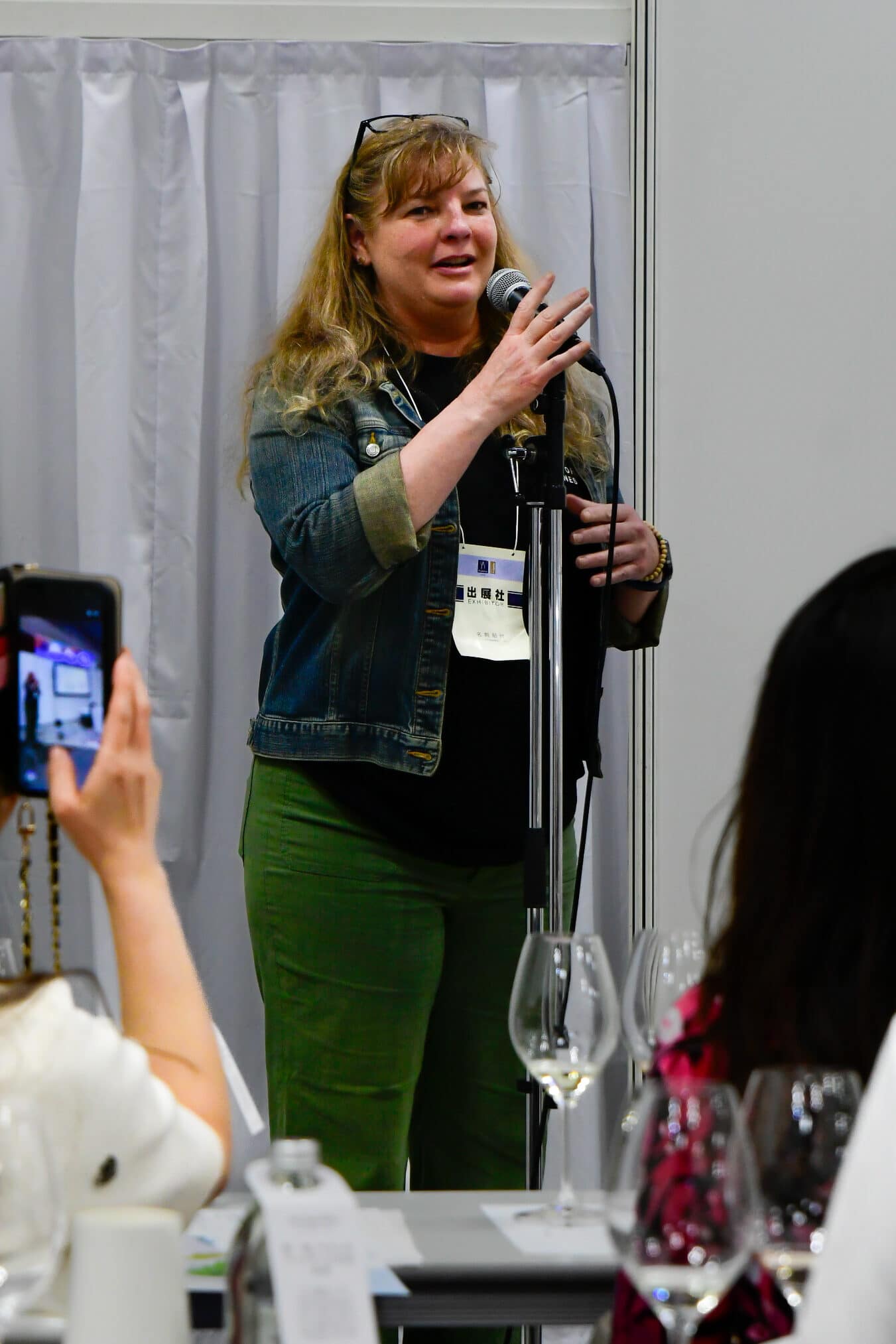
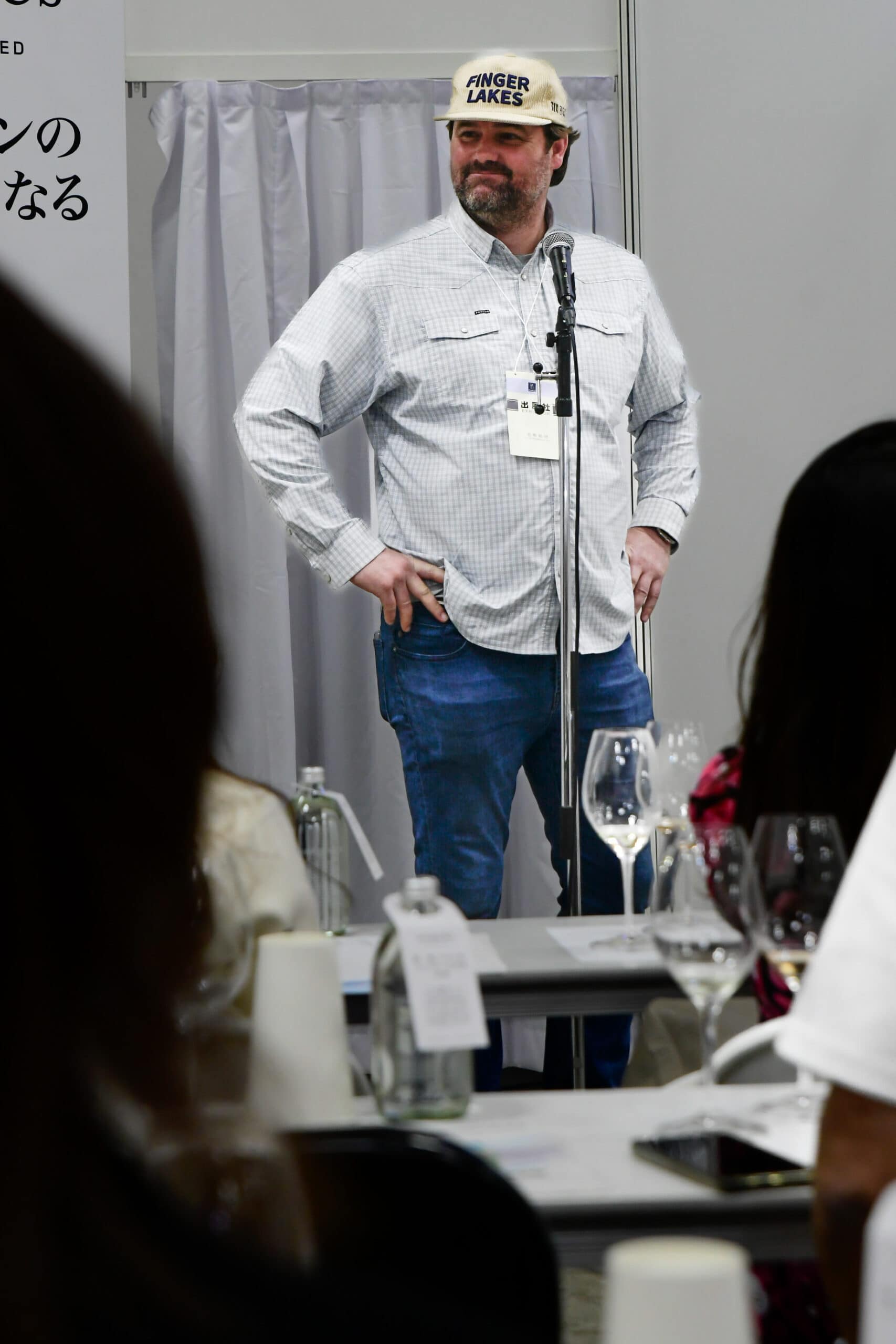

The New York Wine & Grape Foundation, established by New York State statute in 1985, held a booth under their “Bold NY” positioning.
Kyle Anne Pallischeck, Director of Programs at the NYWGF – a Finger Lakes native with a Court of Master Sommeliers certification – was leading the delegation, alongside Dave Pittard, who owns two Cayuga Lake wineries: Buttonwood Grove in Romulus, and Six Eighty Cellars in Ovid, Kelly Ashford, the National Sales Director of Fox Run Vineyards in the Finger Lakes, and Mario Mazza, of Mazza Chautauqua Cellars in Lake Erie.
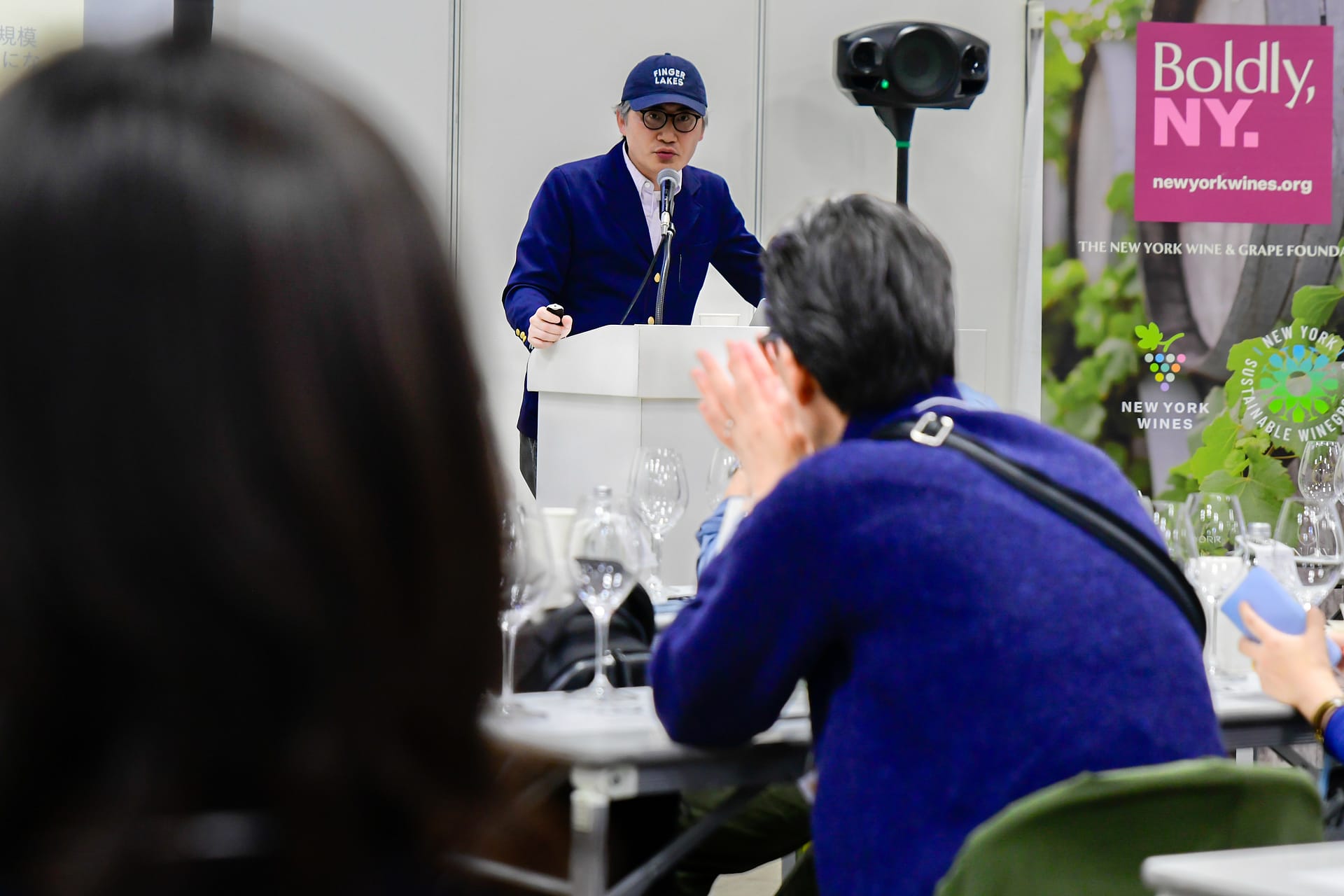
Their masterclass, led by Mr. Takenori Beppu of the NYWGF Japan office, offered an informative glimpse – and a taste – of a region that remains largely unknown in Asia despite being one of the fastest developing wine regions. New York counted just 19 wineries in 1976; it now has over 450, spread across seven distinct AVAs, from the cool-climate Finger Lakes to the maritime influence of Long Island, working with around 40 different wine varieties. Three of those are native American grapes – Concord, Niagara and Catawba – varieties with deep roots in American agricultural history but far removed from the European winemaking tradition: Concord, the most widely planted of the three, is better known as the grape behind Welch’s grape juice and the jelly of the American peanut butter and jelly sandwich than as a wine grape. New York is, however, in the middle of a deliberate shift towards Vitis vinifera, varieties that produce the most structured, age-worthy wines. Among those, the most popular are Riesling, Chardonnay, Merlot, and Cabernet Franc, which is now being proposed as the ‘official’ red wine grape of the New York State.
MADE IN AKITA (BY DANSHIKO LAB)
Behind a small booth filled to the brim with all sorts of bottles, I found the rather touching story of Made in Akita (made-in-akita.com) – a curated platform representing sake, beer, cider, and spirits from Akita Prefecture.

“Geographically, Akita is not easily accessible from major cities like Tokyo or Osaka,” explains Takuya Iwata, the founder. He originally came to Akita intending to acquire a brewery, but after meeting with the locals and taking in the spirit of the place, something shifted. “While it is one of Japan’s leading regions for producing high-quality goods, it remains overlooked, and the population is declining faster than anywhere else in the world. Seeing industries struggle in such an environment made me realise something – I felt a strong urge to take these products to the world on behalf of the producers who work tirelessly to create them.” Akita is indeed the prefecture with the highest proportion of elderly residents in Japan – 38.6 per cent of its population is aged 65 or older – and faces a projected population loss of 41 per cent by 2045. It is home to generations of talented sake and beer artisans, but those artisans were ill-equipped to adapt to modern forms of trade and export. Rather than extract a single asset, Iwata and his CMO Shohei Nagashima decided to build around the situation and become the bridge that would bring Akita’s products to the outside world. Made in Akita now provides the export platform, the curation, and the international positioning that these producers would otherwise have no practical pathway to achieve. Iwata’s stated ambition leaves little room for ambiguity: “When people hear ‘Japan,’ they think of a special country. ‘Tokyo’ brings to mind a cutting-edge metropolis, ‘Kyoto’ represents tradition, and ‘Kobe’ is synonymous with world-class steak. I want to create a world where hearing the name ‘Akita’ immediately triggers the thought: ‘That’s where the best drinks in Japan come from.'”
At their booth visitors could sample sake from multiple Akita houses, a gin called Taiheizan GIN No 65, and apple cider and sparkling pear under the brand mia, presented with the modern look of natural wine. An interesting find was oga. GOSHADO, a wild sour ale brewed on Oga’s rugged coast using sea salt and native microorganisms in the style of a Belgian lambic – a brand created by Danshiko Lab themselves, based on a product originally crafted by a local brewer they invest in, and completely rebranded for the international market. It is exactly the kind of product the project is built around: exceptional local craftsmanship, reshaped into something that travels.
Their flagship sake range is OKD, from Okuda Sake Brewery founded in 1673 – a house that has been making sake through the entire arc of modern Japan, from the Edo period through two world wars and the collapse of the Soviet Union, and is now reaching international trade buyers for the first time. Alongside it sit Dainagawa Junmai Ginjo, Chitosezakari Junmai Daiginjo, Okuda’s Chiyomidori, and Chokai Homare – each a distinct producer from across the prefecture, each representing a different facet of Akita’s brewing tradition. Everything I tasted was top quality – and I can’t recommend them enough.
GREECE: NOSTIMIA AND ALPHA ESTATE

The Greek Chamber of Commerce in Japan and the importer Nostimia – 有限会社ノスティミア – organised a masterclass on Greek wine, to be delivered in Japanese. Since I don’t speak Japanese, Marina Fragkis, who has been the company’s chief buyer since joining in 2020, ran me through the same tasting in English and I am so grateful to her for being so generous with her time.
Nostimia was started by her father in 2001, when there was simply nothing Greek in the Japanese wine market. Marina studied biology in the UK and decided to join the family company at 22. She now travels to Greece once a year to visit their suppliers and bring her first-hand experience and their stories back for the Japanese trade. Today, Greek wine accounts for 0.43 per cent of all wine imported into Japan – and that’s a situation it encounters often with the countries it exports to and that will only change with more educational work and the creation of opportunities for consumers to experience these wines.
We tasted four. A single-variety Assyrtiko (2024), by Karavitakis winery in Crete, kept at low temperature after harvest, macerated, then fermented in stainless steel. Assyrtiko has a tendency to retain acidity even in very hot climates like Crete, which gives it a citrus and mineral profile with real persistence.
ΑιΩ Marbled Malagouzia 2024, by Sacred Mountain winery in Halkidiki: aged in tanks built from marble: the marble’s micro-porosity allows slow micro-oxygenation, which the winemaker uses deliberately to smooth the texture. The result is round, floral, and expressive – white peach, herbs, fresh acidity – with a softness that is specific to this winemaking choice.
The third was the single variety Xinomavro “Hedgehog” 2023 from Alpha Estate in Amindeo, grown on sandy soils over limestone, surrounded by lakes that moderate the continental climate of north-western Macedonia. Light-bodied and elegant, with a slim structure, fresh acidity, red fruits and tomato.
The fourth wine was Thelema 2021, a 50/50 blend of Mavrotragano and Xinomavro from Zin Ideos Winery, in Halkidiki. Full-bodied, the two grape varieties were vinified separately then matured for 18 to 24 months before blending. Mavrotragano originates in Santorini, where it had nearly disappeared before being revived – it brings coffee, smoke, red fruits, and minerality to the blend. Rich and layered, this is a wine that works on its own as much as with food.
Next to the lovely family-owned importers of Nostimia, I was happy to find the only Greek winery I had had the chance to try in Vietnam: Alpha Estate. Founded in 1997 by viticulturist Makis Mavridis and oenologist Angelos Iatridis, their 220 hectares in Amyndeon are entirely privately owned, and the daughters of both founders – Angeliki Iatridou and Emorfili Mavridou – are now actively part of the team, carrying the project into its second generation.

Amyndeon sits in the far northwest of Greece, close to the borders of Albania and North Macedonia, hemmed in by three mountain ranges, as far from the coast as Greece can be and with a fully continental climate – cold winters, dry summers, with wide variation between day and night temperatures. It is possibly the coolest place in Greece to grow grapes. The vineyards themselves lie on a plateau between 600 and 700 metres of altitude, on soils so sandy that phylloxera was never able to invade. One plot, Barba Yannis, dates back to 1919 and still shows ungrafted pre-phylloxera specimens producing on their original roots.
Their range covers both indigenous varieties such as Malagouzia, Assyrtiko and Xinomavro, and international ones. Their higher tier, sourced from single vineyards and single blocks, features on its labels the animals known to visit these particular plots. I was particularly impressed by their single block wines, such as their Assyrtiko ‘Aghia Kiriaki’ and their Malagouzia ‘Latipes’, which both demonstrated excellent balance and splendid notes of stone fruits, as well as a certain creaminess I would have loved alongside some grilled octopus and lemon chicken.
Some of Alpha Estate’s wines are currently available in Vietnam through Warehouse and the Annam Group.
GEORGIAN WINES
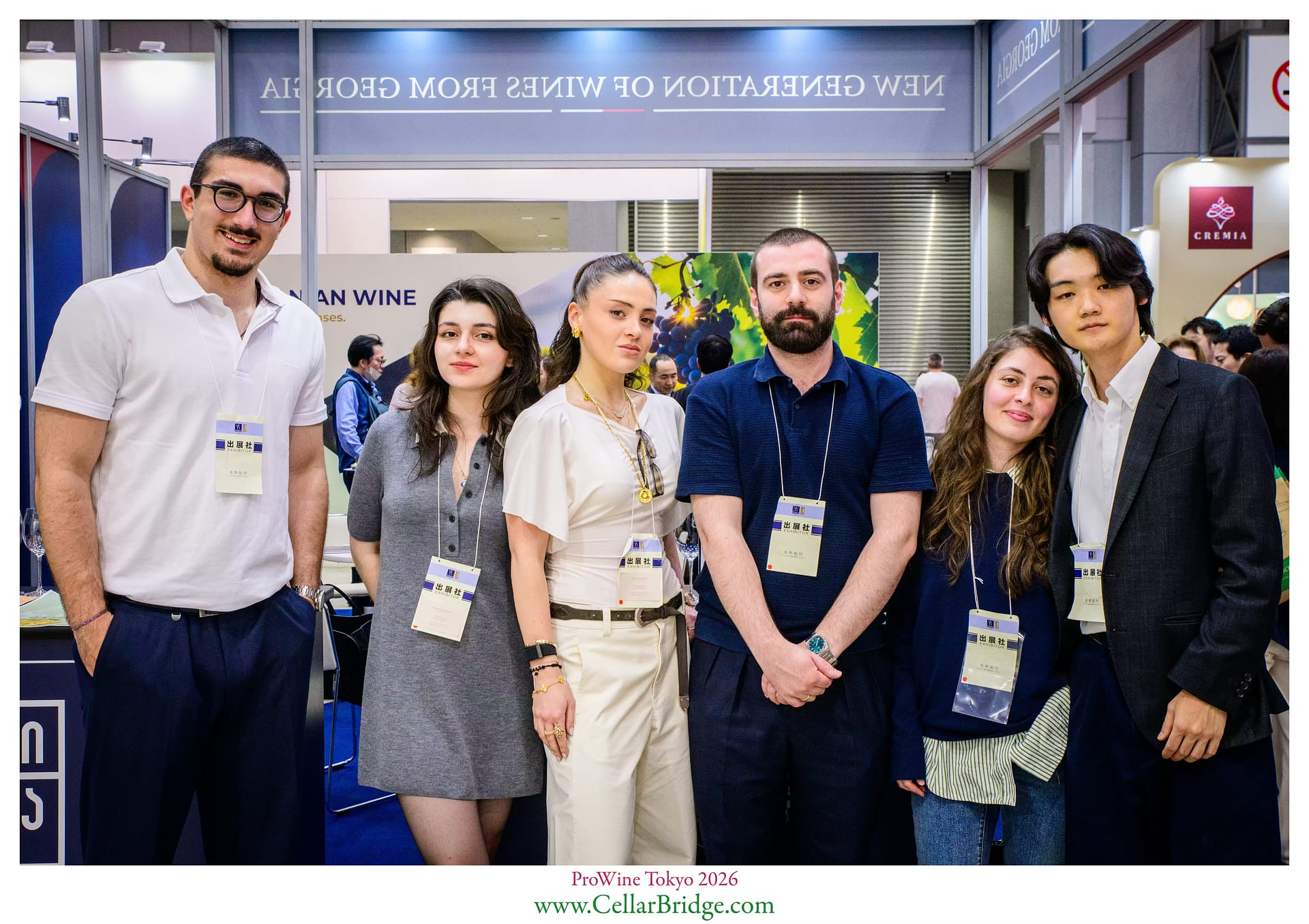
The Georgian pavilion was one of the biggest draw for me, mostly because of my personal attachment to the country and their wines. The booth was shared by 7 wineries: Binekhi, Brother’s Avaliani, Gurgenidze family, Mesaubre, Bimbili, Royal Ikalto, and Vine Era.
A masterclass they called “New Generation Wines from Georgia”, was led by David Tamarashvili (CEO and Owner of Vine & Wine group) and Konstantine Tchanturia (Sommelier of the Binekhi team).

As most people know by now, the country of Georgia currently holds the title of the cradle of wine, with its winemaking history extending approximately 8,000 years.
The country boasts more than 500 identified native grape varieties across 29 distinct microzones. David Tamarashvili, put that figure into perspective with characteristic precision: the diversity of a single small western Georgian region like Racha or Adjara exceeds what most countries can claim in their entirety.
That framing matters, because the international market still tends to reduce Georgia to Kakheti, Saperavi, and Qvevri – which are definitely parts of its hallmark but remains only a small part of what the country has to offer.
The masterclass was accompanied by a tasting of no less than 8 wines.
We started with Binekhi Winery, founded in 1994, and their Khikhvi Qvevri. Khikhvi is an ancient Kakhetian white grape – low-yielding, aromatic, with a signature of ripe yellow fruit, apricot, and citrus blossom that makes it particularly well-suited to skin-contact winemaking. With skin contact for two weeks during fermentation, followed by a further six months of maceration, it demonstrates the characteristic structure that confuses first-time drinkers: deep amber colour, honey and dried apricot on the nose, and a tannin grip on the palate that comes from the seeds and skins.
David Tamarashvili then presented Vine Era’s Sauvignon Blanc Qvevri, with full inclusion of stems, seeds, and skins, fermented at 14 to 15 degrees Celsius over several months. Such a refreshing and unexpected take on Sauvignon Blanc which bears very little resemblance to the well-known Loire Valley or New Zealand Sauvignons. The grapes at harvest were at their best: 25 brix sugar, 6.5% acidity and a pH of 2.8 – a quality raw material that gives the winemaker considerable room to work.
The third wine came from MESAUBRE winery – whose name translates from Georgian as “talk to me”. A lovely Kakhuri Mtsvane from Akhmeta, 2022 vintage, from 16-year-old vines, with full stem, seed, and skin inclusion.
We then had a dry Rosé from Ortomeli winery, made from Chkhaveri – a grape native to the western regions of Adjara and Guria, with naturally pinkish skin that can yield white, pink, red, or sparkling wine from a single variety – a technical versatility well appreciated by winemakers.
The fifth wine nearly brought me to tears. Binekhi winery presented their Saperavi Reserve Qvevri: fermented in large oak vats, aged two years in French oak, then held a further five years in bottle before release. In Georgia, Saperavi is somehow as ubiquitous as Cabernet Sauvignon in the rest of the world. You’ll often stumble over very average quality, if not plain poor versions. But when you find a great one, you stop and smile. Even though it is sometimes easy to forget, Saperavi really can be that good. And Binekhi managed to make one just like that.
The sixth pour was Vine Era’s Mukuzani Saperavi – Mukuzani being one of Kakheti’s most celebrated PDO microzones, reserved exclusively for dry Saperavi. Another superb wine from a very new winery whose modern architecture is, by Georgia’s current standards, genuinely striking: unapologetically contemporary and yet fitting perfectly in its natural environment.
The seventh wine was Bimbili’s Aleksandrouli Reserve 2020. Aleksandrouli is most widely known as one half of Khvanchkara, Georgia’s celebrated semi-sweet PDO from Racha. Here it was made dry – a less common choice that puts the grape’s natural character front and centre: soft tannins, lively acidity, and bright red fruit without the sweetness most drinkers associate with the variety.
We concluded with the Avaliani Brothers and their Usakhelauri. The name means “nameless” in Georgian – a grape so particular that locals felt it could not be compared to anything else. It grows on steep slopes between 400 and 700 meters in Lechkhumi, near a handful of villages, and most attempts to cultivate it elsewhere have failed. Yields are tiny, harvesting entirely by hand, and fermentation stops naturally as cellar temperatures drop in winter, preserving residual sugar without any intervention. Annual production is typically measured in hundreds of bottles, therefore placing it in a higher price range – well worth the cost if you find a good one. I once had an unforgettable one in a supra in Lechkhumi and I still regret to this day not having been able to purchase a couple bottles – the winemaker made it for his family only and wouldn’t sell it. If you visit Georgia – go on the hunt for the grape with no name!

Final Impressions




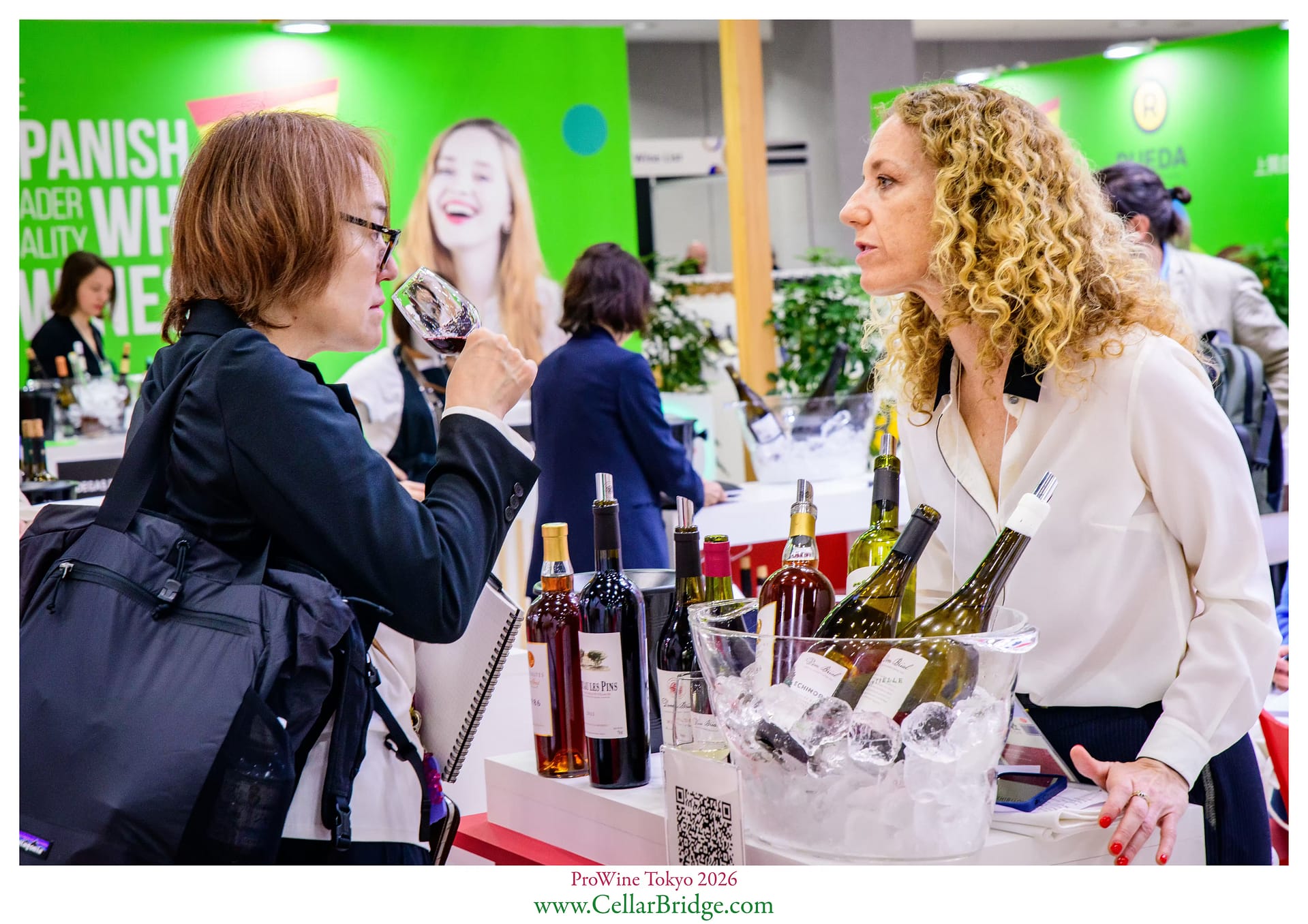
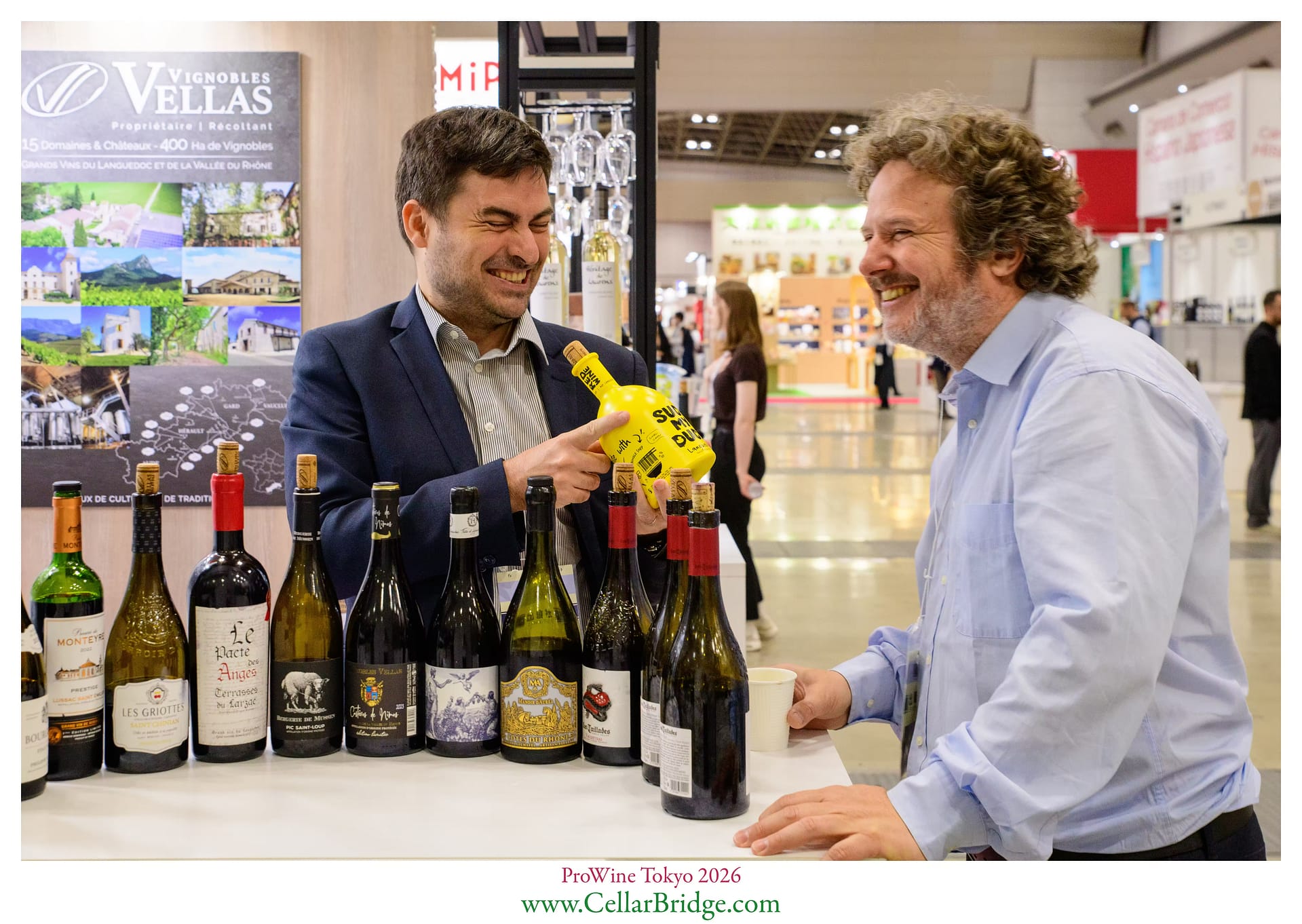
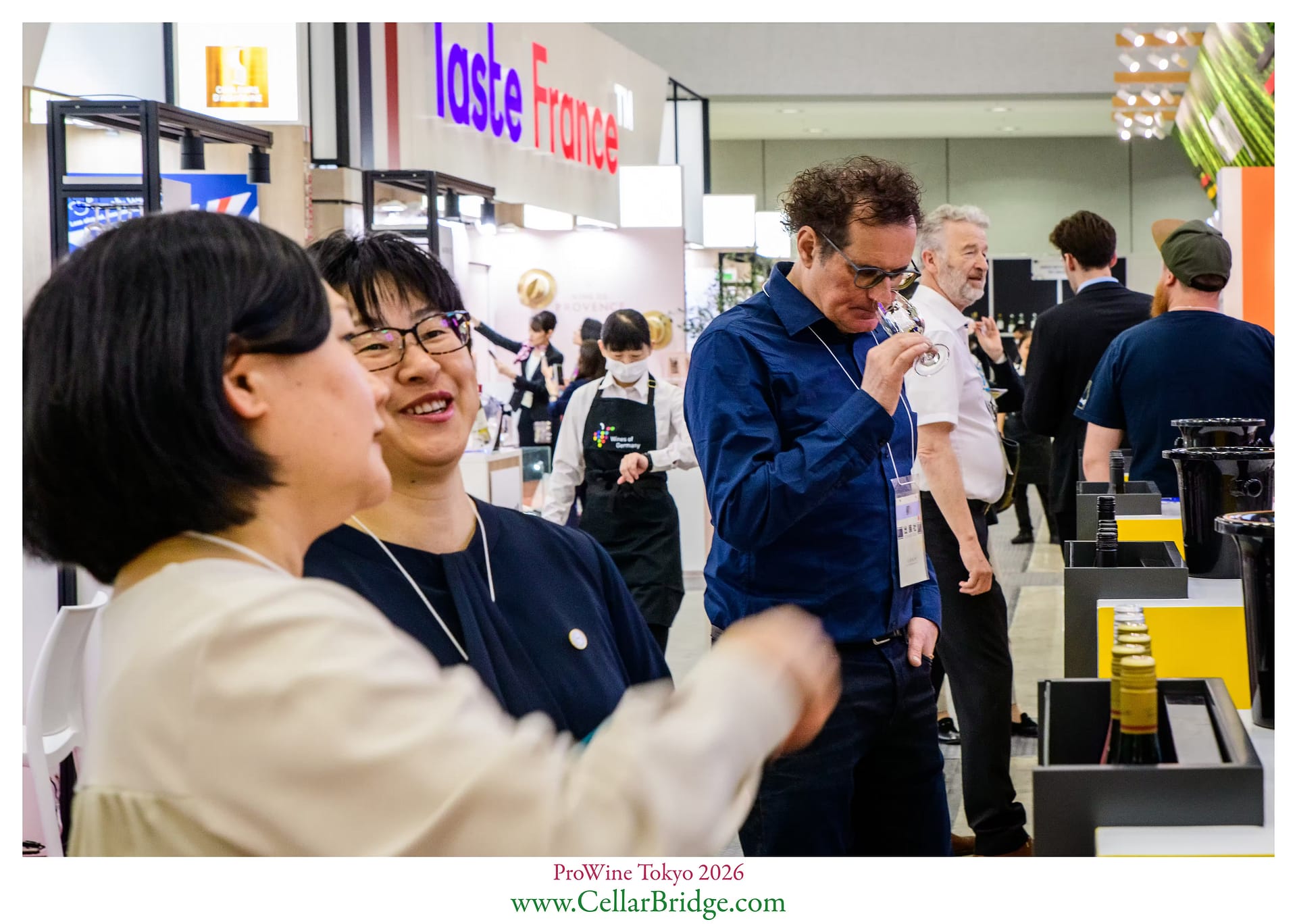


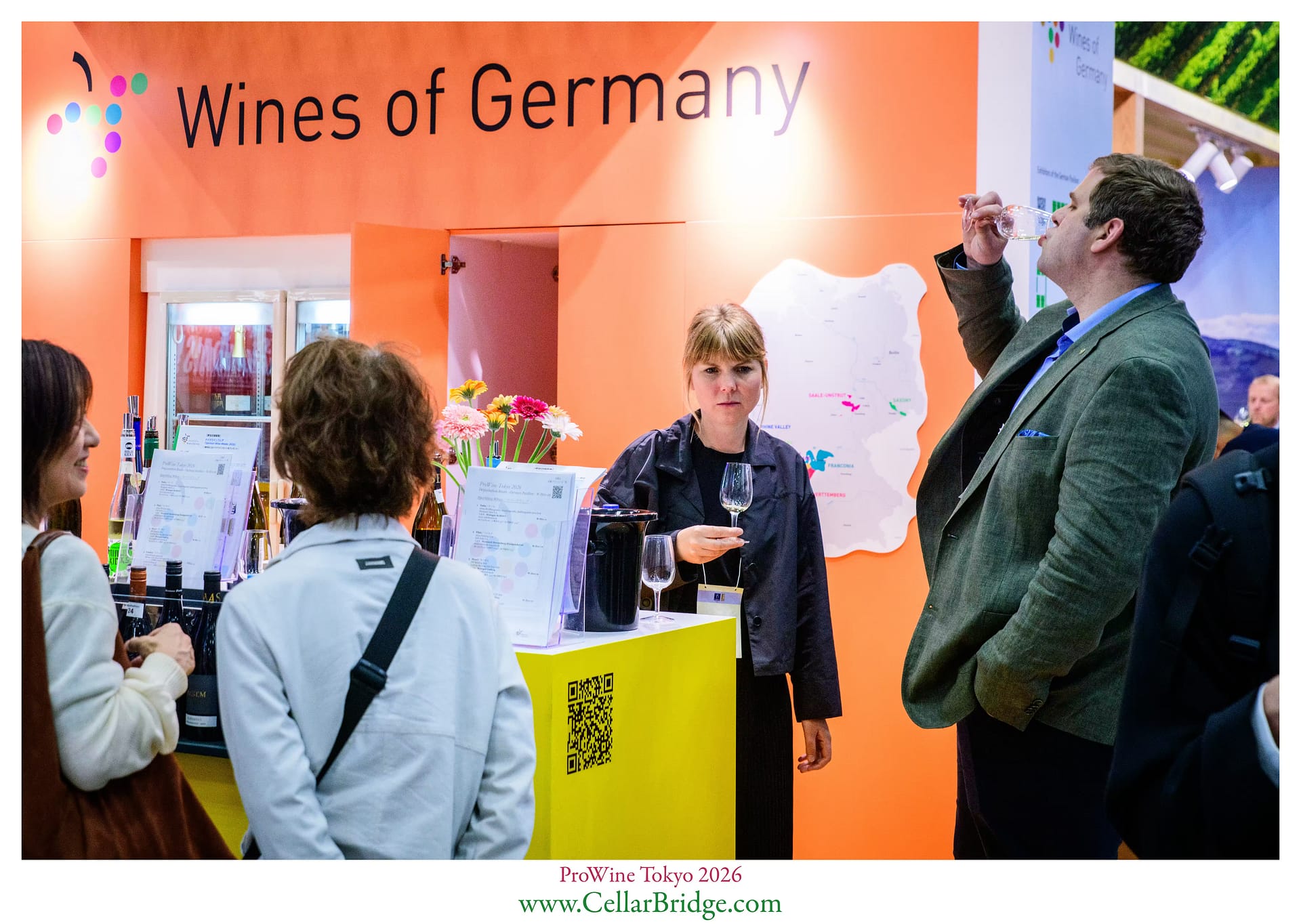
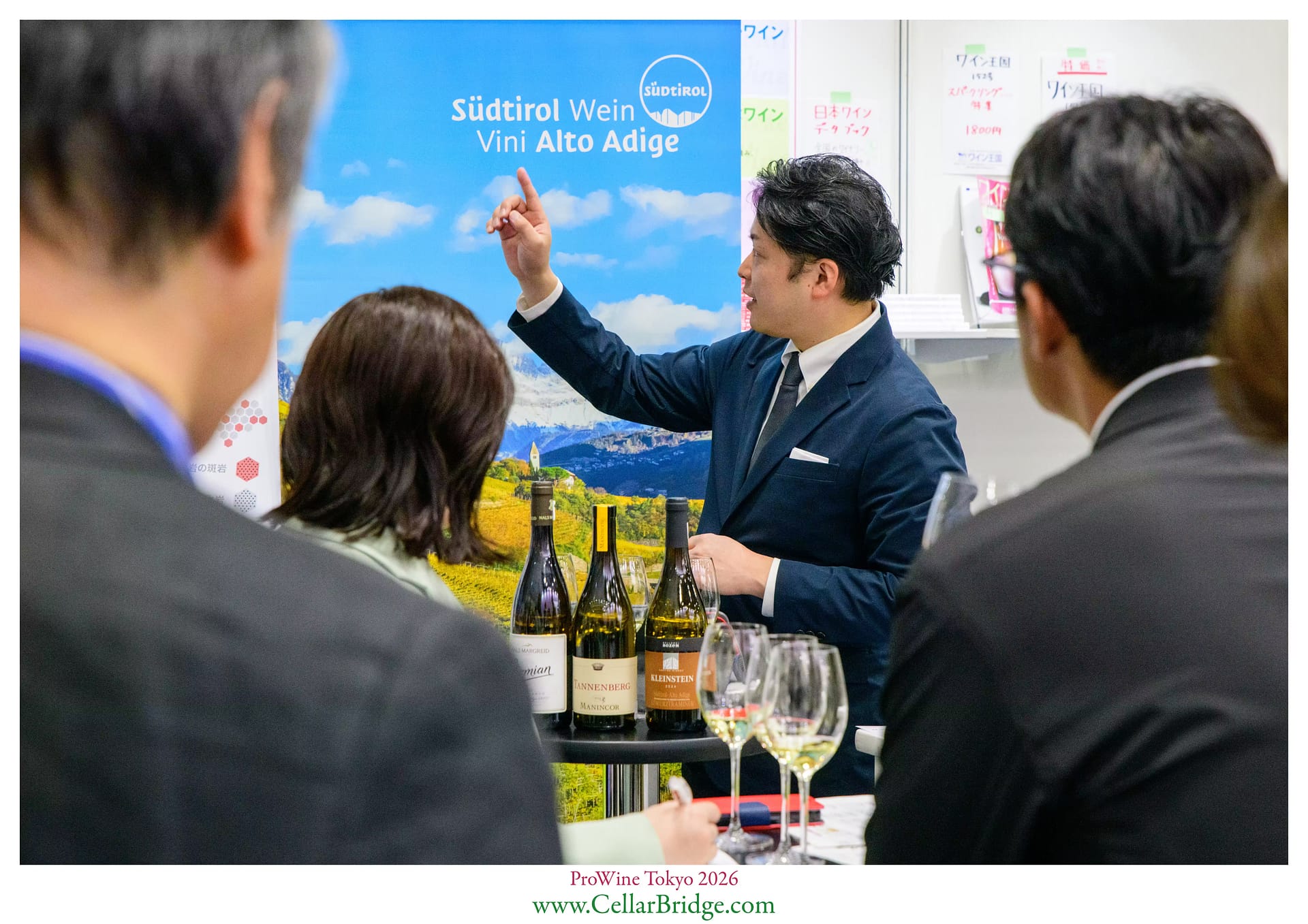

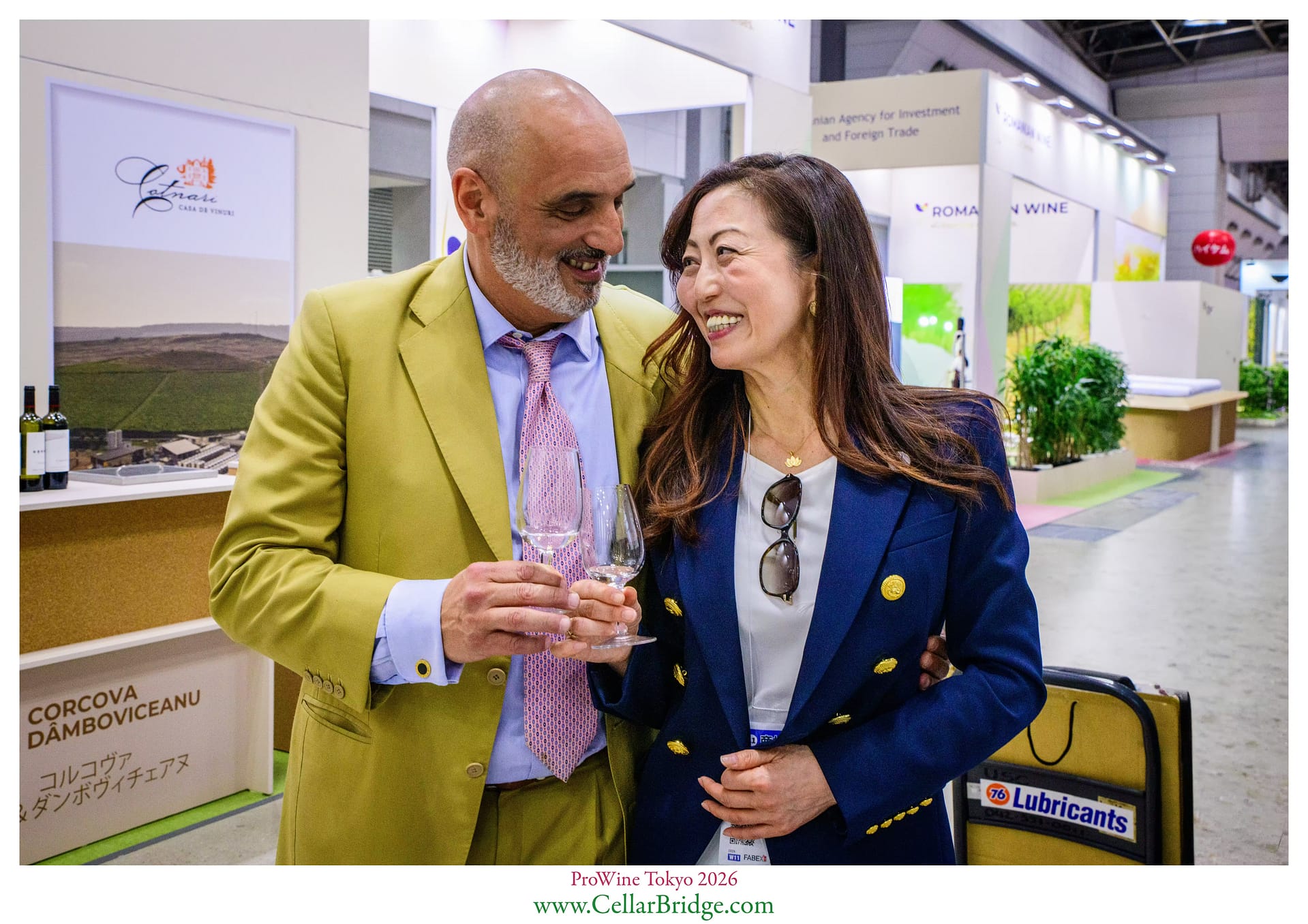
The venue itself may not be as sexy as some of its competitors and the language barrier in masterclasses is a genuine obstacle (even with the translation app that was provided, it was hard to follow), but one couldn’t ignore the genuine effervescence that was at play. What I witnessed was real communication: people taking the time to taste and ask questions, camaraderie between the producers, and plenty of smiling faces, from the opening hours till closing time. And the most important to me was access – to Georgian winemakers who do not show up in Singapore or Hong Kong, to Serbian producers building serious relationships in unfamiliar territory, to Greek wines rarely as present in other Asian fairs and to boutique projects like Made in Akita and Chalu Sparkling Teas. These were 3 intense days but I would gladly have stayed double that long – and doesn’t that say it all?
It’s all about showing up, creating connections and opening your horizons and on that front – ProWine Tokyo 2026 aced it.